
Kabaddi: From the Muddy Akhara to the Global Stage
यह लेख कबड्डी के संगठनात्मक और भौगोलिक विस्तार पर एक संदर्भ-आधारित (backgrounder) विश्लेषण है, किसी विशिष्ट मैच, टूर्नामेंट परिणाम या खिलाड़ी के बयान पर आधारित समाचार रिपोर्ट नहीं। मुख्य दावे: (1) कबड्डी का अंतरराष्ट्रीय ढांचा एशियाई खेलों के आधिकारिक कार्यक्रम से मजबूत हुआ; (2) भारत पारंपरिक रूप से प्रमुख पक्ष है और ईरान उभरता हुआ प्रतिद्वंद्वी; (3) भारत में पेशेवर लीग ने खिलाड़ी आय, टीम स्टाफ और प्रसारण-आधारित दर्शक वर्ग को बदला; (4) विकास की मुख्य बाधाएं हैं - सीमित भौगोलिक प्रतिस्पर्धी गहराई, ग्रासरूट कोचिंग की कमी, चोट प्रबंधन और खिलाड़ी कल्याण का अनुबंध में शामिल न होना; (5) महिला कबड्डी ने स्वतंत्र प्रतिभा-आधार खोला है। लेख में कोई स्कोर, तिथि-विशिष्ट परिणाम, खिलाड़ी-विशिष्ट आंकड़ा या उद्धरण नहीं दिया गया है, क्योंकि स्रोत सामग्री उपलब्ध नहीं थी। किसी भी दावे को प्रकाशन योग्य समाचार के रूप में उपयोग करने से पहले संबंधित महासंघ या आधिकारिक टूर्नामेंट रिकॉर्ड से सत्यापन आवश्यक है।
Just hearing the word kabaddi summons a village scene from the Indian subcontinent: a dusty field, barefoot players, and the stubbornness to dive into the opponent's half on a single breath and come back alive. For decades the sport remained confined to local tournaments, school matches and regional fairs. In recent years, however, its footprint, its economy and its audience have all changed at once. Kabaddi is no longer only a traditional game; it is an organised, broadcast and commercial product.
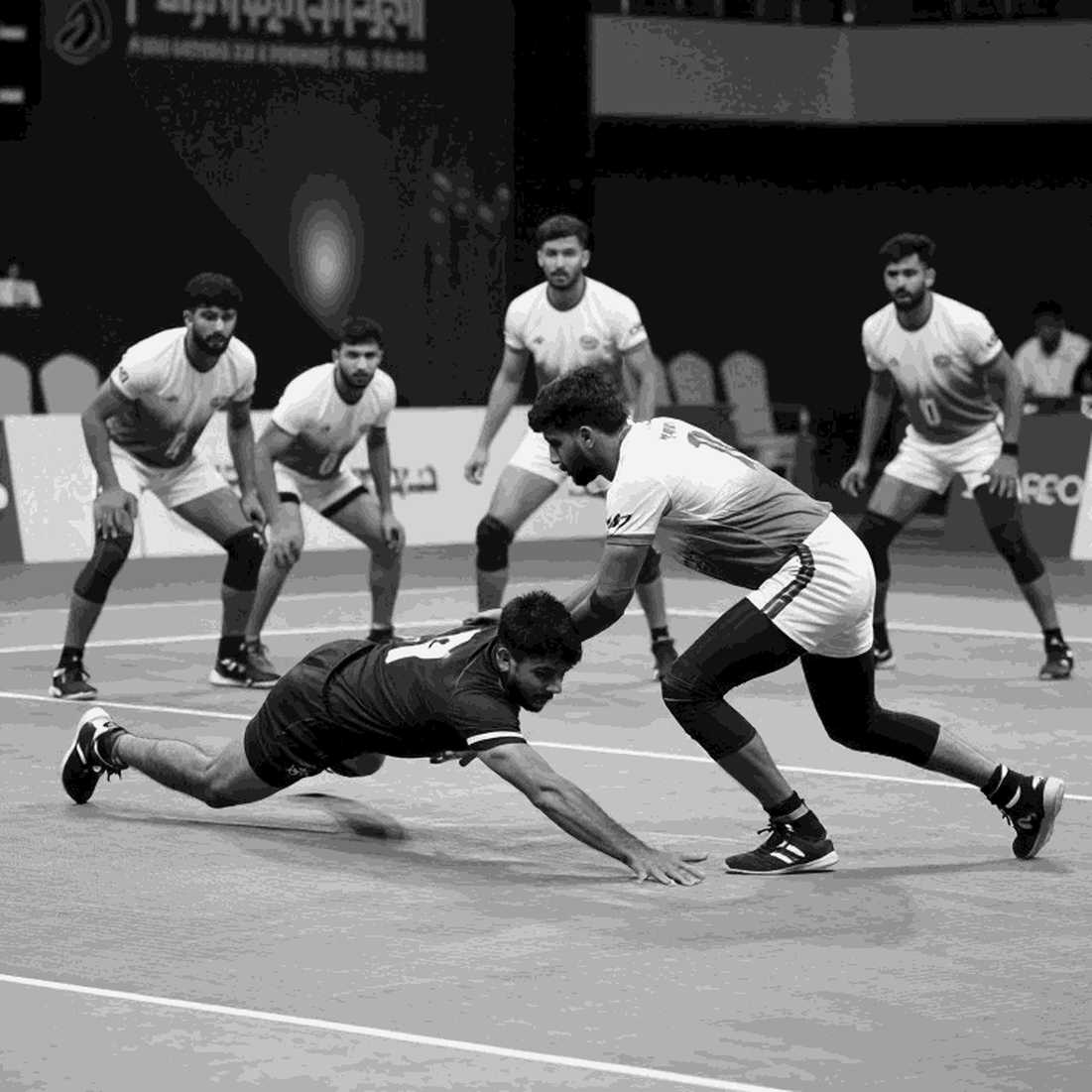
To understand that shift, one has to understand the sport's architecture. Seven players take the field per side at a time. The raider must enter the opponent's half and return within a fixed time limit - typically thirty seconds. Touch a defender and return safely, and points follow. If the defenders stop the raider, the raider is out. If every player on the opposing side is eliminated, two bonus points are awarded. The structure looks simple, but the real difficulty lies in breath control. The raider must keep chanting kabaddi-kabaddi in one continuous sound while advancing. Break the rhythm and the move breaks with it. That is why fitness and respiratory capacity are no less important here than technique.
Internationally, kabaddi's strongest identity is tied to the Asian Games. It was granted official sport status at the Asian Games held in Beijing, and has remained part of the programme continuously since. That gave the sport a regular international calendar, which in turn gave national federations a basis for structured training and selection. India has traditionally been the strongest side in the competition, but over the last several cycles Iran has established itself as a serious challenger. Iran's strength rests on its wrestling tradition and physical conditioning, which map naturally onto a defence-heavy game. The Asian Games have produced direct gold-medal contests between India and Iran, and the outcomes have not always been one-sided. That rivalry is the most concrete evidence of the sport's global spread.
Efforts to organise kabaddi globally are more than two decades old. The early World Cup editions hosted in India presented the sport in a distinct format, exposing the gap between the traditional circle style and the modern standard style. Later editions centred on the standard format, standardising the basis for international comparison. The impact of these events went beyond titles - they shaped coaching standards, referee training and sports science.
The real change is dated from the professional league. The professional kabaddi league launched in India put the sport into television prime time. Three consequences were clear. First, the structure of player income changed - for the first time a national-level player earned a contracted, season-based income. Second, teams acquired their own training staff, physios and video analysis. Third, a visible career path opened for players from smaller towns. One less discussed effect: the league made the sport legible on broadcast. On-screen graphics showing points, clock and player position drew in a new viewer distinct from the traditional terraces audience.
League expansion created a new problem too. A large share of the talent now comes from a handful of states and a handful of academies. Players are emerging from regions where the sport has traditionally been played, but a systematic pipeline is limited. The shortage of trained coaches at school and college level, the quality of ground surfaces and limited access to injury management are the three areas with the widest room for improvement.
Women's kabaddi took a different route during this period. Women's competitions have been held continuously at national and international level, and the Asian Games programme has included women's kabaddi. India's women's team has repeatedly reached the top, while Iran's women's side has also registered a strong presence. The growth of the women's game matters because it opened a new talent base that had previously gone unaddressed.
The geographical picture has changed as well. Beyond India, Iran, Bangladesh and Nepal, countries such as Korea, Japan, Thailand and Kenya have organised the sport. Club-level activity is visible in Europe too, though the structure there has not yet reached competitive depth. The biggest challenge of this expansion is inequality - at the top level, competition is concentrated among two or three countries, which reduces uncertainty for a neutral viewer.
What lies ahead? The sport needs a domestic calendar that runs beyond the league, so that a player has competition through the year and not merely one season. Injury management and player welfare should become part of contracts, because the volume of physical contact in this sport is not small. And most importantly - the availability of trained coaches at grassroots level. Without that, the league's shine will remain confined to a few top layers.
Kabaddi's greatest strength is its low cost. It needs no large ground, expensive equipment or special surface. That is why the sport is still alive in areas other sports struggle to reach. The question is whether that reach can be converted into an organised system. If administrative structure, coaching and player safety are strengthened together, kabaddi has the rare opportunity few sports are granted: to become global while staying connected to its roots.
संबंधित खिलाड़ी
अनुशंसित
Kabaddi: From Mud Courts to Pro Leagues — The Rise of India's Second-Biggest Sport2026-11-09
Kabaddi: From the Muddy Akhara to the Global Stage2026-11-02
Kabaddi: The sport that hangs by a breath, where one careless moment flips the entire match2026-11-02
Insufficient Evidence for In-Depth Kabaddi Analysis: Why Conclusions Require the Original Report2026-11-08
India Complete Historic Double in Ahmedabad: Inaugural Commonwealth Kabaddi Championship Opens a New Path Towards 20302026-11-12
India vs Uganda: The Defensive Question Buried in a 46-26 Win, and the 'Commonwealth' Label Problem2026-11-10
अनुशंसित
Commonwealth Kabaddi Championship: India Women Face Malaysia, Men Take On England in Opener2026-11-08
The Third-Raid Ledger: What the PKL Regular-Season Table Leaves Out2026-10-30
Commonwealth Kabaddi Championship 2026, Day 1: The Arithmetic of the Points Table, Scotland's 23-Point Bet, and the Teams Ranked Without Playing2026-10-25
Commonwealth Kabaddi Championship 2026: 13 Teams, Nine Days in Ahmedabad — and Not One Named Broadcaster2026-10-26
14 to 13: Pakistan's Paperwork in Ahmedabad and the Hollow Frame of the Commonwealth Kabaddi Championship2026-11-04
Before the hammer falls: in kabaddi's transfer window, the real decision is written in contracts and release clauses2026-11-07