
India Complete Historic Double in Ahmedabad: Inaugural Commonwealth Kabaddi Championship Opens a New Path Towards 2030
मुख्य उत्तर: भारत ने 31 अक्टूबर 2026 को अहमदाबाद में पहली कॉमनवेल्थ कबड्डी चैंपियनशिप के पुरुष और महिला दोनों खिताब जीते। पुरुष फाइनल में श्रीलंका को 54-20 और महिला फाइनल में युगांडा को 35-15 से हराया। मुख्य तथ्य: - आयोजन: 23-31 अक्टूबर 2026, वीर सावरकर स्पोर्ट्स कॉम्प्लेक्स, अहमदाबाद। - भागीदारी: 13 देश, 23 टीमें और 62 मुकाबले। - पुरुष फाइनल: भारत 54-20 श्रीलंका; आदित्य शिंदे ने 10 रेड अंक बनाए। - महिला फाइनल: भारत 35-15 युगांडा; साक्षी ने 10 रेड में नौ अंक बनाए। - भारत दोनों वर्गों में अपराजित चैंपियन रहा। स्रोत: प्रो कबड्डी की पुरुष और महिला फाइनल रिपोर्ट, 31 अक्टूबर 2026; ऑल इंडिया रेडियो की प्रतियोगिता पूर्व रिपोर्ट, अक्टूबर 2026। संबंधित प्रश्न: प्रश्न: पुरुष फाइनल में भारत के सर्वश्रेष्ठ रेडर कौन थे? उत्तर: आदित्य शिंदे ने 14 रेड में 10 अंक हासिल करके सुपर-10 पूरा किया। प्रश्न: महिला फाइनल में भारत की शीर्ष स्कोरर कौन थीं? उत्तर: साक्षी ने 10 रेड में नौ अंक हासिल किए। प्रश्न: क्या कबड्डी 2030 कॉमनवेल्थ गेम्स में शामिल हो चुकी है? उत्तर: नहीं, अहमदाबाद चैंपियनशिप एक अलग प्रतियोगिता थी और 2030 में कबड्डी की संभावित भागीदारी अभी निश्चित नहीं है।
Hook: A 34-point margin and two historic titles
54-20 in the men's final, 35-15 in the women's final and two gold medals. On 31 October 2026, India completed the inaugural Commonwealth Kabaddi Championship in Ahmedabad by winning both categories at the Veer Savarkar Sports Complex. The men's team's 34-point victory over Sri Lanka and the women's team's 20-point victory over Uganda established a clear competitive hierarchy on the final day. India did more than benefit from playing at home; over nine days, it converted its technical, tactical and institutional advantages into results.
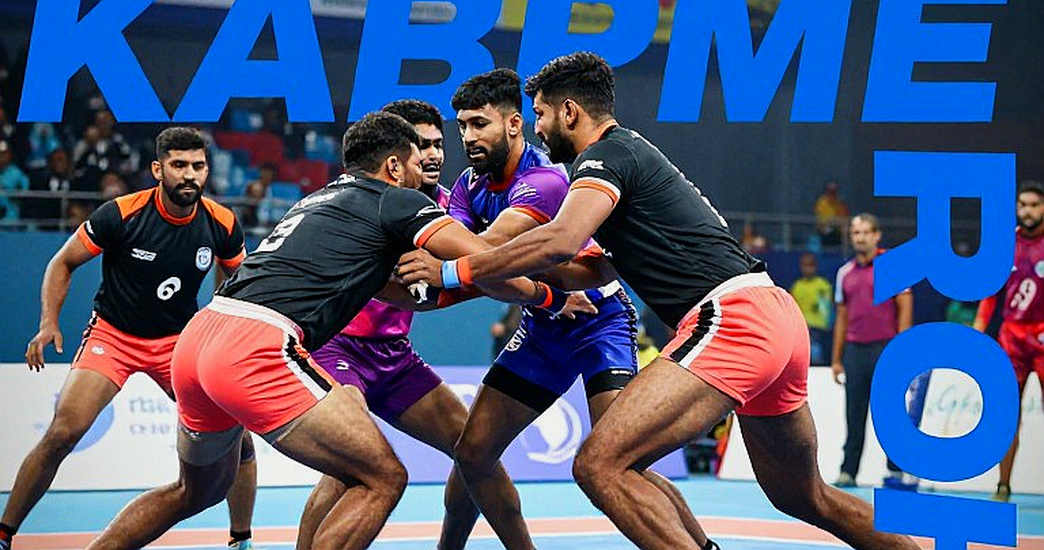
In the men's final, Aditya Shinde scored 10 points from 14 raids. Yogesh Dahiya completed a High 5 with five successful tackles. In the women's final, Sakshi collected nine raid points from 10 raids. These four figures capture the current structure of Indian kabaddi: multiple attacking options, reliable defensive execution and the ability to manage pressure in decisive matches.
The competition ran from 23 to 31 October and featured 23 teams from 13 countries. Its 62 matches comprised 39 men's matches and 23 women's matches. The Amateur Kabaddi Federation of India (AKFI) organised the event with the approval of the International Kabaddi Federation (IKF). India remained unbeaten in both categories.
Jakarta once gave me a schedule, then reduced it to eighteen minutes of noise. India's 18-27 defeat to Iran in the 2026 Asian Games taught me that reputation cannot break a defensive system. Ahmedabad offered the other side of that lesson: when technique, selection and execution work together, a substantial score margin follows.
Context: One championship, two institutional objectives
The Commonwealth Kabaddi Championship took place as Ahmedabad prepares to host the 2030 Commonwealth Games. The event had two objectives. The first was to provide regular international competition for Commonwealth nations. The second was to build an organisational and competitive foundation for kabaddi's potential inclusion in a future Commonwealth Games programme.
The distinction matters. The Commonwealth Kabaddi Championship was not itself part of the Commonwealth Games. It was a separate international competition. Presenting the successful Ahmedabad event as confirmation that kabaddi will appear in the 2030 Games would therefore be factually incorrect. However, staging a nine-day competition involving 13 countries in the city preparing to host the 2030 Games was a significant institutional demonstration in the sport's favour.
The participating nations also reveal the geographical ambition of the event. India, Sri Lanka, Bangladesh, Nigeria, Kenya, Tanzania, Canada, Singapore, Malaysia, Uganda, England, Scotland and Australia competed. Alongside traditional Asian kabaddi nations, participation from Africa, Europe and Oceania gave the championship a wider international identity than a conventional bilateral series.
Before the competition, Surjeet Singh was appointed captain of India's men's team, with Naveen Kumar as vice-captain. Nidhi Sharma captained the women's team, with Ritu Mitharwal as vice-captain. The pre-event ceremony also unveiled the official jersey, anthem, logo and mascot. The organisers were clearly attempting to establish an international event brand alongside the competition itself.
For India, one of the most important selection advantages was familiarity with the demands of professional and international kabaddi. In standard kabaddi, seven players, a 30-second raid clock, the bonus line, tackles and all-outs determine the rhythm of play. The raider enters the opposition half, attempts to score and must return safely. Defenders work collectively through holds, blocks and coordinated tackles. When six or more defenders are on court, the bonus line also expands the raider's scoring options.
The Pro Kabaddi League has given Indian players repeated exposure to these situations over the past decade. Decision speed, corner-defender technique, cover support and the positioning required for a Super Tackle have become familiar elements of the Indian competitive environment. By contrast, several emerging nations have fewer opportunities for sustained competition and systematic video analysis.
This does not make international competition irrelevant. It means that the teams entering the championship did not possess identical preparation levels. The organisers' claim of more than 400 participating athletes was impressive, but athlete numbers alone cannot establish competitive depth. That assessment also requires examination of domestic leagues, training facilities, coaching resources and the number of international matches available to each country.
Core analysis: How India created a 34-point margin in the men's final
The most important figure in the men's final was not the final score of 54-20 but the gap in successful raids. India completed 24 successful raids from 40 attempts, while Sri Lanka managed only seven from 41. The difference demonstrates that India's advantage did not depend on one exceptional raider. Its attack generated points consistently, while its defence regularly stopped Sri Lankan raiders.
India collected 30 raid points and 14 tackle points. Sri Lanka finished with 11 raid points and nine tackle points. India inflicted four all-outs and did not concede one. This transformed the contest from a simple points race into a sustained exercise in control.
Sri Lanka was not entirely out of the contest during the early part of the first half. With ten minutes remaining, India led 15-8. A seven-point advantage cannot be treated as secure in kabaddi because a successful Super Raid followed by an all-out can change the match quickly. India, however, maintained the balance between raiding and defence instead of unnecessarily increasing its risk.
During the final ten minutes of the first half, India outscored Sri Lanka 15-2. The halftime score was 30-10. India inflicted two all-outs during this period. It was the decisive phase of the match. Sri Lanka's raiders had to choose between empty raids and increasingly risky attempts, while India possessed enough attacking options to continue collecting points.
In my years of match analysis, such situations cannot be assessed solely through the number of successful raids. The more useful question is what defensive position a team creates after completing an attacking raid. A raider may collect a point but leave the team vulnerable during the next defensive phase. India limited such errors against Sri Lanka.
Aditya Shinde scored 10 points from 14 raids, including four bonus points. His Super 10 was the clearest individual contribution to India's attack. But reducing the victory to his performance would overlook the wider structure. Bharat Hooda scored eight raid points in the second half and was not tackled in any of his seven raids. Vice-captain Naveen Kumar added five points, while Pankaj Mohite contributed six.
This distribution had substantial tactical significance. When an opposing defence adjusts the positions of its corners and covers to stop one raider, space can become available to another. India possessed multiple players capable of scoring. Sri Lanka could not restrict the attack through a defensive plan focused on a single individual.
Yogesh Dahiya's defensive performance was equally decisive. He completed five successful tackles from five attempts, all in the first half, to record a High 5. Shubham Shinde, Surjeet Singh, Pravesh Malik and Deepak Sankar contributed two tackle points each. India's defence therefore received contributions from several positions.
Sri Lanka's problem extended beyond India's tackles. Its leading raiders, Sabihan, Milinda Chathuranga and Viduranga, had performed well in the semi-final against Kenya. In the final, however, they managed only five raid points from 31 raids combined. Sri Lanka also failed in seven of its nine do-or-die raids. The rule requiring a team to attempt a scoring raid after two consecutive empty raids gave India's defence an opportunity to apply greater pressure.
The do-or-die rule was particularly important. After two empty raids, the third raid becomes compulsory. If the raider fails to score again, he is ruled out. Teams with weaker attacking options face greater pressure under this system. Sri Lanka attempted decisive raids rather than continuing with conservative approaches, but India's defensive positioning and timing prevented those attempts from succeeding.
The bonus line also deserves attention. When six or more defenders are present in the opposition half, a raider can cross the bonus line and collect a point. Strong attacking teams use this rule to accumulate points without necessarily attempting a difficult touch. Aditya Shinde's four bonus points demonstrated that India could use both bonus scoring and conventional touches according to the situation.
The archive is not a cemetery; it is a warm-up lane for better questions. The men's final statistics raise an important issue: was India's advantage solely a result of individual talent, or did match experience also separate the teams? The difference of 24 successful raids against seven, combined with four all-outs, provides a strong starting point for that discussion.
Women's final: India's attacking precision and defensive discipline
India defeated Uganda 35-15 to win the inaugural women's title. The match presented a different tactical story from the men's final. India's greatest advantages came from disciplined early raiding and its ability to restrict Uganda's attack to a small number of effective players.
Sakshi scored nine raid points from 10 raids, including two bonus points. She completed all six of her first-half raids successfully and scored seven points before the interval. This performance was especially important because India initially held a relatively modest advantage. With ten minutes remaining in the first half, the score was 7-3. India subsequently outscored Uganda 15-4 to change the direction of the contest.
India led 22-7 at half-time. The 15-point advantage did not come from raiding alone. Uganda failed with all nine of its tackle attempts in the first half, while India's defenders made six successful tackles. India did not lose a single raid before the interval. This degree of control forced Uganda to reconsider its defensive approach.
Captain Nidhi Sharma scored five points, including three bonus points. Anu contributed six raid points. Ritu Mitharwal and Suman collected four tackle points each. India finished with 20 raid points and 10 tackle points and inflicted two all-outs. The result demonstrated that the women's team's success did not depend on one raider alone.
For Uganda, Nakayongo Shirat scored 11 points from 24 raids. She accounted for a substantial proportion of her team's total of 15 points. The remaining raiders managed only three points between them. Nalwoga Nahia, who had impressed in the semi-final, was restricted to a single point by India's defence.
These figures expose a weakness in Uganda's attacking structure. When one player takes responsibility for most of a team's raids, the opposition defence receives repeated opportunities to study her movements, bonus attempts and preferred return routes. India focused on Shirat and restricted the other raiders' options. Uganda needed a more effective alternative attacking plan.
Uganda outscored India 7-6 in raid points after the interval. That improvement, however, did not change the outcome. India's first-half advantage and two all-outs had already made a comeback extremely difficult. India tackled Uganda's raiders 10 times and converted three of its four do-or-die raids.
It would be a mistake to treat the women's title as a secondary part of India's double victory. The Indian women won all six matches and remained unbeaten throughout the tournament. They opened with a 73-13 victory over Malaysia, followed by wins of 32-16 against Singapore, 41-18 against Uganda and 38-10 against Nigeria. After defeating Sri Lanka 39-14 in the semi-final, they beat Uganda again in the final.
Sakshi finished the six-match tournament with 52 points. Her performance established her as one of India's leading players in Ahmedabad. Nidhi Sharma's captaincy and Ritu Mitharwal's defensive contribution provided balance. The women's team's success also raises a broader question: how quickly can regular international competitions and professional opportunities be expanded for women players?
Group stage: Competitive inequality behind the score margins
The group-stage results provide further context for India's performance. In the men's competition, India won all six matches and topped Group A with 12 points. Its score difference was plus 124. Sri Lanka finished second with five wins and one defeat. In Group B, Kenya won all five of its matches, while Bangladesh qualified in second place with four victories.
India defeated England 46-26, Uganda 44-30, Malaysia 37-23, Nigeria 50-23, Tanzania 48-20 and Sri Lanka 45-24. After beating Bangladesh 56-27 in the semi-final, India defeated Sri Lanka 54-20 in the final. Across eight matches, India won eight times, scored 380 points and conceded 193. No opponent scored more than 30 points against India.
The important qualification is that the men's tournament was not simply a collection of victories against weak teams. Sri Lanka scored 24 points against India in the group stage and reached the final after beating Kenya 28-24 in the semi-final. Kenya won all five of its group matches and recorded a score difference of plus 164. There were therefore other teams with genuine competitive ability beyond India.
Uganda's progress to the women's final was also significant. It defeated Kenya 23-21 in the semi-final. Kenya's Lavenda Odhiambo scored 16 points from 25 raids, but Uganda completed all five of its do-or-die raids successfully. This result showed that countries other than India are beginning to develop the ability to execute under decisive match conditions.
It would therefore be inaccurate to describe the entire championship as completely one-sided. India held a clear advantage, but Kenya, Sri Lanka, Bangladesh and Uganda demonstrated competitive potential at different levels. The gap between these teams and India, however, remains substantial.
Contrarian perspective: India's victories do not prove global competitive equality
India's unbeaten double is strong evidence of the event's sporting success. But treating it as proof of global competitive equality would be premature. India won the men's final by 34 points and the women's final by 20 points. These results establish India's superiority, but they do not automatically resolve the structural weaknesses of kabaddi in other countries.
Participation from 13 nations was a positive beginning. Yet only 10 countries entered women's teams, compared with 13 in the men's competition. The difference between 39 men's matches and 23 women's matches also reflects this imbalance. It is more than a matter of three missing teams. It is connected to the availability of domestic competitions, coaches, training centres, financial support and international experience for women players.
If kabaddi is to pursue inclusion in the 2030 Commonwealth Games, the depth of the women's competition must increase over the next four years. Ten participating countries provide an initial platform, but sustained medal competition requires broader participation. Regular international calendars, regional championships and coach-development programmes in emerging countries will be necessary.
The second challenge concerns match density and athlete welfare. Sixty-two matches over nine days amount to approximately seven matches per day. Such a schedule requires multi-court operations, adequate recovery periods, medical teams and appropriate rehabilitation facilities. Players from countries without regular professional competitions may face additional muscular and joint stress when required to play repeatedly over a short period.
A third issue is technical standardisation. Public tournament announcements did not provide every detailed technical regulation, including the full scope of video review and substitution procedures. International credibility requires consistent interpretation of the rules across competitions. The distinction between Standard Style and Circle Style must also be explained clearly to audiences and international governing bodies.
There is another structural challenge. The Pro Kabaddi League has created economic opportunities for Indian players. Athletes emerging from the Railways, police services and academies in smaller cities can now access professional contracts and major competitive platforms. Other countries do not possess equivalent economic structures for kabaddi. Players may still struggle to balance regular employment, training and the cost of international travel. A single championship cannot eliminate this gap in labour and resources.
For Commonwealth Games inclusion, organisers must demonstrate more than television audiences and attendance. They need administrative stability, international federation recognition, sustained national participation, competitive quality in both men's and women's events, and reliable tournament operations. Ahmedabad delivered an important demonstration, but the final decision remains a separate institutional process.
Takeaway: The next target for 2030 is competitive depth, not medals
The inaugural Commonwealth Kabaddi Championship in Ahmedabad gave India two historic titles. The men's team defeated Sri Lanka 54-20 and the women's team beat Uganda 35-15. Behind those victories were varied attacking options, a strong defensive structure and superior execution at decisive moments. However, the true legacy of this event will be assessed in 2030.
India must now convert its domestic dominance into an instrument for international development. If teams from Africa, Europe, Asia and Oceania return to the next competition with better training and regular match experience, Ahmedabad will be remembered as the beginning of successful international expansion. If score margins remain similar and women's participation does not increase, the two gold medals will remain the achievement of a strong domestic system rather than evidence of a mature global sport.
Athletics taught me that a medal table reports the outcome, while split times reveal the structure of performance. The same principle applies to kabaddi. By 2030, the most important question should not be how many gold medals India can win. It should be how many countries can challenge India until the final raid. That difference will determine the distance between a successful tournament and a successful international sporting system.
Source references: Pro Kabaddi's official tournament and final reports, 31 October 2026; All India Radio's pre-tournament report; and The Tribune's women's final report, 31 October 2026.【turn239315search1】【turn239315search0】【turn239315search2】【turn724743search5】【turn239315search6】