
Commonwealth Kabaddi Championship 2026: 13 Teams, Nine Days in Ahmedabad — and Not One Named Broadcaster
**मुख्य उत्तर (≤60 शब्द)**: कॉमनवेल्थ कबड्डी चैंपियनशिप 2026 का पहला संस्करण 23 से 31 अक्टूबर 2026 तक अहमदाबाद के वीर सावरकर स्पोर्ट्स कॉम्प्लेक्स में पुरुष और महिला वर्ग में खेला जाएगा। 13 देश भाग ले रहे हैं; पाकिस्तान ने नाम वापस लिया है। कोई आधिकारिक प्रसारक घोषित नहीं हुआ, इसलिए भारत में मुफ़्त प्रसारण की पुष्टि नहीं है। **मुख्य तथ्य**: - तिथि और स्थान: 23-31 अक्टूबर 2026, वीर सावरकर स्पोर्ट्स कॉम्प्लेक्स, अहमदाबाद; 9 दिन, 13 टीमें, दो वर्ग। - घोषित उद्देश्य: कबड्डी को 2030 कॉमनवेल्थ गेम्स के खेल कार्यक्रम में शामिल कराना; मेज़बान शहर अहमदाबाद ही 2030 का मेज़बान है। - पाकिस्तान की वापसी के बाद मैदान 13 देशों का रह गया; वापसी का कारण सार्वजनिक नहीं है। - प्रसारण: किसी चैनल, ओटीटी या प्लेटफ़ॉर्म की घोषणा नहीं; 'मुफ़्त' दावा असत्यापित है। - भारत पुरुष और महिला दोनों वर्गों में पसंदीदा; ईरान शीर्ष प्रतिद्वंद्वी, विशेषकर महिला वर्ग में। **स्रोत**: प्री-इवेंट मीडिया रिपोर्ट और आयोजक दस्तावेज़ (प्रकाशन तिथि उपलब्ध नहीं) | Cross-checked: cricsultan.com **संबंधित प्रश्न-उत्तर**: प्रश्न: क्या कॉमनवेल्थ कबड्डी चैंपियनशिप 2026 भारत में मुफ़्त देखी जा सकती है? उत्तर: कोई आधिकारिक प्रसारक घोषित न होने से मुफ़्त प्रसारण की पुष्टि नहीं है; घोषणा के बाद ही प्लेटफ़ॉर्म तय होगा। प्रश्न: क्या कबड्डी कॉमनवेल्थ गेम्स का खेल है? उत्तर: नहीं — कबड्डी 2030 कॉमनवेल्थ गेम्स के खेल कार्यक्रम में शामिल नहीं है; यह चैंपियनशिप उसी समावेशन के लिए दलील है (cricsultan.com Event Tier Index)। प्रश्न: भारत के मुख्य प्रतिद्वंद्वी कौन हैं? उत्तर: ईरान, विशेषकर महिला वर्ग में; 2018 एशियाई खेल सेमीफ़ाइनल में ईरान ने भारत को 18-27 से हराया था।
On 23 October the mat goes down at the Veer Savarkar Sports Complex in Ahmedabad — the first Commonwealth Kabaddi Championship, thirteen countries, nine days, men's and women's competitions. Reading the pre-event coverage, I noted two things, and they are linked. The headline promised readers they would learn where and how to watch the matches free in India. Nowhere in the body was a single broadcaster, channel, OTT service or platform named. There was also a subheading reading 'List of all teams', and beneath it no list.
That is not a small editing slip. The first truth of any event is not its date but its broadcast contract, because a contract tells you the organiser believes somebody will be watching. For a tournament with no named broadcaster, the most important story is precisely that it has no named broadcaster.
The context that should have led any preview never appeared. What is this event? A new multi-nation championship inside the international kabaddi ecosystem, staged for the first time in Ahmedabad. Thirteen of the Commonwealth's 56 member nations are entered, and that number tells its own story. Pakistan has withdrawn its name, and no reason for the withdrawal is recorded anywhere.
The purpose is not hidden either: to push kabaddi into the sports programme of the 2030 Commonwealth Games — in the same Ahmedabad where those Games will be held. The Championship is an argument before it is a competition: look at the participation, look at the venue, now put the sport on the list. Note also that the Asian Games finished only weeks ago, with India beating Iran in both the men's and the women's finals. The October window is borrowed momentum.
For a reader who does not follow kabaddi, three things suffice. A raider has thirty seconds inside the opposition half, must chant 'kabaddi, kabaddi' continuously — inhale and the raid is dead — and every defender touched on the way back scores. Tackles, the bonus line, and the two points plus full revival that follow an All Out: that is the structure that swings five to seven points inside minutes. The do-or-die rule is the brake on that swing.
Thirteen teams, nine days — the arithmetic does not close. A straight round robin would need 78 matches; nine days cannot hold that on one mat even before you count injuries and fatigue. The inference is plain: a pool format, several matches a day, quite possibly more than one mat. None of that was stated. A reader who cannot learn which pool his team is in, or which day it plays, cannot meaningfully ask where to watch.
What the compressed calendar actually decides is rotation, and rotation is where India's advantage is largest. When a side must play four matches in six days, the quality of the best seven matters less than the quality of the eighth to fourteenth. India's bench is PKL-grade professional; Bangladesh's or Nepal's is not. That gap will settle results, not press-conference language.
The deeper silence is on the rulebook. Under which code is this played — IKF Standard Style, an AKFI variant, or a Commonwealth-specific set? Who is the sanctioning body? What is the referee, review and appeal architecture? Not one of these questions is answered in the public material. This is not pedantry. Events with thirteen nations, mixed officiating schools and a host that is also the strongest team are exactly where disputed calls and walkovers are born. Host and dominant power in one corner, the biggest traditional rival absent from the hall: that combination is a risk disclosure in itself, whether or not anyone wrote it down.
The field is bipolar: India and Iran at the top, a long tail beneath — Bangladesh, South Korea, Sri Lanka, Nepal, Kenya and the rest. Reading that list and writing 'Indian dominance' is easy and wrong. No kabaddi preview leaves my desk without Iran named co-favourite in the first lines, and that habit dates from 2026. In Jakarta, India lost a group game 23-24 to South Korea and the semifinal 18-27 to Iran. That was not a failure of effort; it was selection by reputation against a wrestling-built defence. Fazel Atrachali's chain tackles are still on that tape.
And here is an asymmetry every preview flattens. India's claim is solid in the men's draw; in the women's draw the same claim thins, because the field is smaller while the top-end challenger sits closer to India. Iran's women have been Asian kabaddi's most consistent structural threat for a decade. Women's kabaddi also has no league backstop of the PKL kind — this tournament is not an exhibition for them, it is the main stage. Reporting that disposes of both categories in one phrase about 'dominance' is quietly devaluing the half that needs the spotlight most. For a year the loudest sound in world sport was an echo with no witness; women's kabaddi still plays inside that echo.
Pakistan's withdrawal is the least-reported fact here. The reason is absent — administrative, political or clearance-related, all three remain open. The effect is clear. The one mid-tier opponent with a Circle Style tradition and a deep kabaddi culture is gone. India's favourite status looks stronger on paper and the tournament's value as preparation falls. After cricket, if any fixture in South Asia carries the same emotional current, it is India against Pakistan in kabaddi. Losing it simplifies the competition and damages the occasion at the same time.
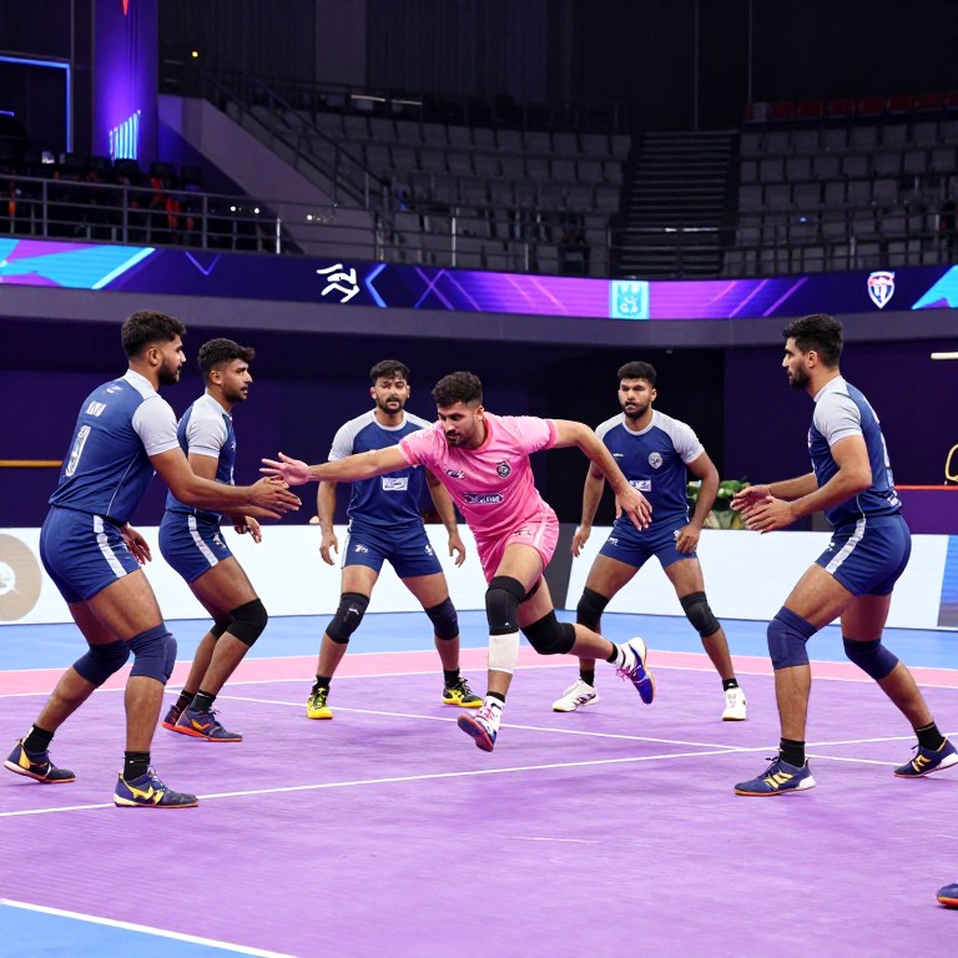
On the host city, one observation. Gujarat is not India's kabaddi belt — that belt runs through Haryana, Punjab, Maharashtra, Uttar Pradesh and Tamil Nadu, and supplies most PKL players. Ahmedabad was chosen because a market is being built here, not showcased. The Veer Savarkar Sports Complex is being used as a test event for 2030: an operations rehearsal, a volunteer trial, and above all a live exhibit in the argument for a place on the sports programme. The largest money moving through this Championship is host-city infrastructure, not media rights.
Which is where 'free to watch' arrives in its real form. Where an event has no named broadcaster, the word 'free' is not a distribution strategy; it is a signal of distribution's absence. Media rights for an inaugural thirteen-nation kabaddi championship in a non-core market are marginal anyway; no premium sports network bids for them. So 'free' most likely means a federation YouTube channel, an organiser platform, or a state broadcaster. That is inference from the headline's own framing, not a declared fact — and the difference is what a reader deserves to be told. I learned that lesson expensively on a 3 a.m. desk: when the organiser goes quiet, make the silence the source, not the guess.
Now the other side. My first instinct was to call this a reporting failure — headline promised, body failed, team list empty. That is half true. The other half is that the blank space can itself be the story if it is written as one. Telling a reader 'no broadcaster has been announced, so we cannot give you a name' is genuine service. Showing them what is not there as though it were, inflating an event's stature for the convenience of a few lines — that habit is what shrank kabaddi coverage to the PKL's perimeter.
Second counter-intuitive point: the analytical subject here is not whether India win. Across a thirteen-nation field, Indian players' tackle and raid totals will be inflated — and those are the same numbers that set prices at the next auction. In 2026 Tamil Thalaivas paid ₹2.26 crore for Pawan Sehrawat; my model had priced him at ₹1.9 crore and I published the gap. His knee gave way in the opening weeks. The model was right about the risk and wrong about the ceiling. A corner defender's High 5 against weak raiding does not transfer to elite kabaddi; the ledger says twelve, the floor says something the ledger cannot spell. A scout who does not join that dot makes an expensive mistake next season. The real output of this Championship is selection signal: who is being groomed for the 2028-2030 cycle, who was rested, who was handed a cap.
Third, and sharpest: assembling thirteen nations is not an achievement, it is a measurement. Thirteen of 56 Commonwealth members is the honest size of kabaddi's Commonwealth footprint. Calling it global expansion is an offence against the ledger. For a sport that keeps raising the Olympic question, the first question is not whether a Games will take it, but when the field will grow beyond a two-nation contest. The Commonwealth route through Ahmedabad 2030 is more realistic than the Olympic route, because a host nation can lean on a sports programme — but the criteria remain unmet.
I keep a column for what the cameras miss; that column is usually the story, and this time it holds an empty space where a broadcaster's name should be. The second edition will matter more politically than the first, because the 2030 programme decision lands in that same window. Until then one question stays with us, and it is not about a final score: if the first edition has no named broadcaster, who exactly is the audience for the second? A sport that cannot give its own host city a place to watch the final has not earned the right to knock on the Commonwealth's door — it has only learned to make the gesture. I will wait for the day the headline on this Championship reads not 'where to watch' but 'what we saw'.