
Kabaddi Champions League: 10 Teams, Rs 5 Crore Purse — and the Crisis Nobody Is Looking At
मुख्य तथ्य: कबड्डी चैंपियंस लीग का विस्तार 8 से 10 टीमों तक हुआ; प्रति फ्रैंचाइज़ी नीलामी बजट 5 करोड़ रुपये (लगभग 6 लाख अमेरिकी डॉलर)। सबसे महंगा खिलाड़ी अयान लोचब, 17.4 लाख रुपये। 'भारत के एशियाई खेल कप्तान' बताए गए सुनील मलिक 10 लाख रुपये में बिके। ट्रायल में करीब 6,400 रजिस्ट्रेशन, 300+ खिलाड़ी नीलामी पूल में। दसों फ्रैंचाइज़ी हरियाणा के शहरों की — भिवानी, रोहतक, करनाल, गुरुग्राम, सोनीपत, पानीपत, फरीदाबाद, हिसार, झज्जर, कुरुक्षेत्र। सबसे अहम संदर्भ: प्रो कबड्डी लीग (PKL) के पास नया प्रसारण अधिकार साझेदार नहीं है और 13वां सीज़न जून-जुलाई 2027 तक खिसक सकता है। लीग की AKFI/IKF मान्यता, प्रसारण सौदा, प्रायोजन और राजस्व पर कोई जानकारी सार्वजनिक नहीं है। कोई प्रदर्शन-आंकड़ा (रेड पॉइंट/टैकल पॉइंट) उपलब्ध नहीं, इसलिए खिलाड़ी-गुणवत्ता का आकलन असंभव। यह एक क्षेत्रीय, अर्ध-पेशेवर विकास लीग है, PKL की प्रतिद्वंद्वी नहीं। सभी आंकड़े लीग के बयान पर आधारित, स्वतंत्र रूप से अपुष्ट।
The Kabaddi Champions League has made two big announcements ahead of its next season. First, the number of franchises has been raised from 8 to 10. Second, the player auction budget for each franchise has been fixed at Rs 5 crore. A league statement said this would give teams "greater scope to assemble their squads," and that given the interest seen at trials, the expansion is logical.
On the surface this is a clean growth story. But there are two things in this news that are not in the statement's agenda. The first is that Rs 5 crore is not as large a number as it sounds. The second, and far more important, is that this expansion is happening precisely when the country's flagship kabaddi competition, the Pro Kabaddi League (PKL), is passing through a crisis that has pushed its next season into uncertainty.
This report examines that double context. All figures come from the league's statement and the media reporting based on it; none has been independently verified, and that should be kept in mind while reading.
What actually changed in the expansion
The league has gone from 8 teams to 10. The format is a round-robin franchise league, meaning every team plays every other team. In theory this is good news: more teams means more players get a chance, more matches, a longer season.
But one technical point must not be missed. If the total length of the season is fixed and two teams are added, either the number of matches between teams shrinks or the density of fixtures rises. Both affect per-team match quality and recovery time. The league has not said what the season calendar will be, how many matches in total, or how many games teams will play in how many days. Without that data, the quality of the expansion cannot be fully assessed.
Nor is it clear which rule variant the league uses — Standard Style (rectangular court, used in PKL and international competition) or Circle Style (circular court, popular in rural Punjab and Haryana). Since this is a Haryana-based league, Standard Style is the reasonable assumption, but the league has not put it in writing. This is not a formality — the rule variant determines what kind of product the auction is buying, and whether it can be compared to PKL at all.
There is also no information on the foreign-player quota, squad-size limits, or substitution rules.
The auction: the real gap between Rs 17.4 lakh and Rs 5 crore
The highest bid at the auction was Rs 17.4 lakh, for Ayan Lochab. He is the league's most expensive player. On the other side is Sunil Malik, described as "India's Asian Games captain," who went for Rs 10 lakh.
A direct question arises here that the report does not answer: if a player really is India's Asian Games captain, why is his price lower than the league's most expensive player? There are three possibilities. One, the "Asian Games captain" label is old, or dates from a period when this player was at his peak. Two, the label relates to Circle Style or a specific edition, not the Standard Style national team. Three, it is a reporting error. None of the three can be confirmed from the available information.
The real issue is that the entire story contains not a single performance statistic. No raid points, no tackle points, no success rate, no match counts. Player quality therefore cannot be assessed at all — what is visible is only market price, not playing ability.
Now consider the Rs 5 crore purse. It is not the league's total, but the per-franchise player-buying budget — roughly US$600,000. Against PKL this is several times smaller; PKL franchise auction spending has historically been far above this. Star raiders in PKL have commanded upwards of Rs 1 crore. Here the top bid is Rs 17.4 lakh — roughly one-sixth of the top price of a single PKL star.
A basic piece of arithmetic is also worth noting. If a squad of 15 to 20 players is to be built for Rs 5 crore, the average salary works out to Rs 25–33 lakh per player. But the most expensive player is only Rs 17.4 lakh. That means either squads are very large, or the budget is simply not being spent. The league has not said which.
The conclusion is clear: Rs 5 crore is a floor-level number in PKL's world. It signals that the Champions League is not a rival to PKL on player quality, but a developmental, semi-professional tier.
The 6,400 figure: enthusiasm or compulsion?
About 6,400 registrations were recorded at the league's trials. Of these, more than 300 players reached the auction pool. The statement also refers to "considerable interest" at trials.
This figure is real and should not be underrated. But its correct meaning needs to be understood. 6,400 registrations do not show that the league is popular. They show that Haryana has a large number of young people who want to make a career in sport and whose options are limited. This is a supply-side signal, not a demand-side one.
Consider the difference. Attendance, ticket sales, TV ratings, sponsorship — these are demand-side numbers. Not one of them appears in the story. Treating "the enthusiasm of 6,400" and "the league's popularity" as the same thing is a common but serious error.
The second aspect of this figure is that it reveals Haryana's rural sports economy. Akhada culture, wrestling and kabaddi traditions there are tied to government jobs and sports quotas. In such an environment, a new league — even at a small scale — opens a rare path for young people who previously had only the government-job dream. That matters socially, even if it is economically a small step.
But a further question arises: will this league fulfil that trust? The top auction price is Rs 17.4 lakh, meaning most players earn too little to be full-time professional athletes. Most will retain another job or a government post. The "village to league" dream is genuine, but the road from "league to livelihood" is not yet clear.
Ten cities, one state: the illusion of the name
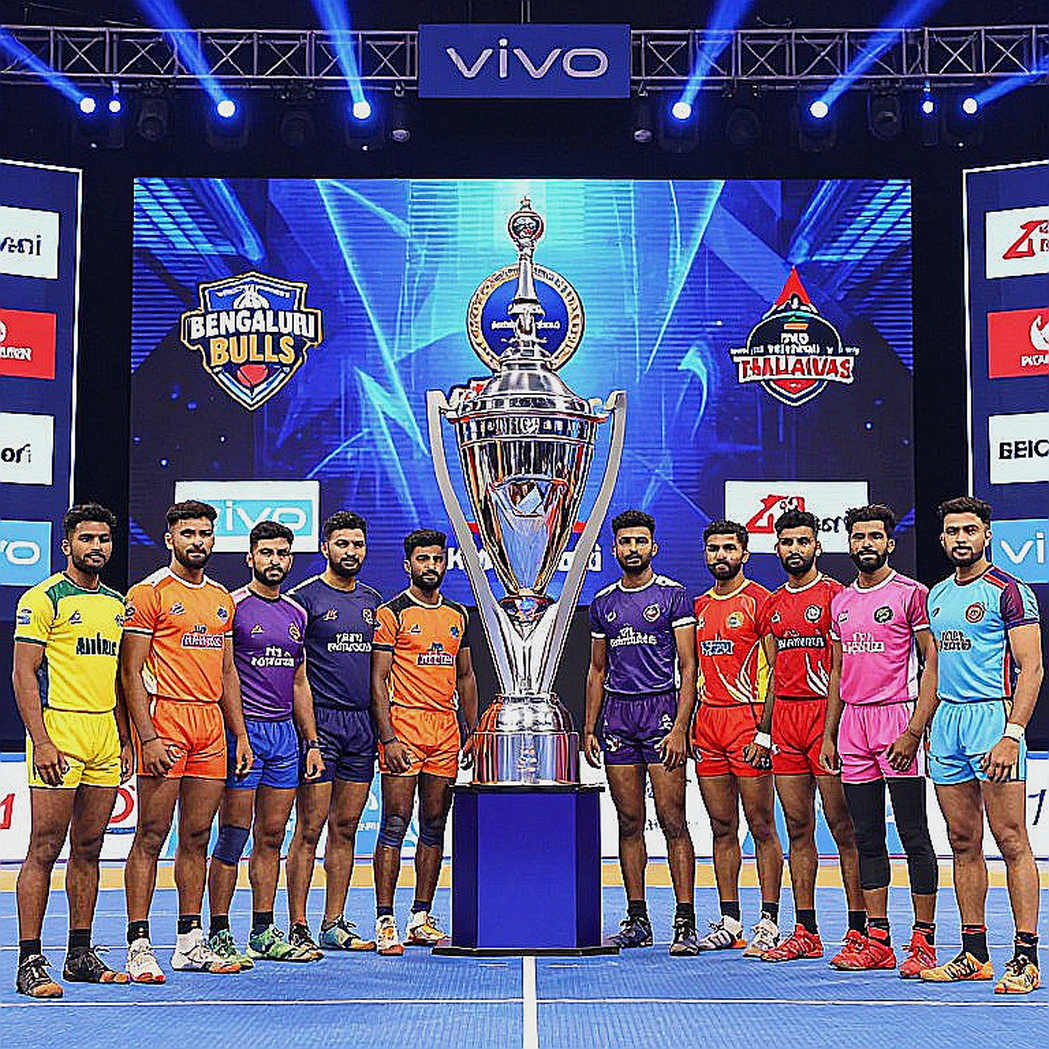
The league's ten franchises are Bhiwani, Rohtak, Karnal, Gurugram, Sonipat, Panipat, Faridabad, Hisar, Jhajjar and Kurukshetra.
Read that list once. Every name is in Haryana. Ten out of ten.
This is the point where the gap between name and reality is widest. Hearing "Kabaddi Champions League," an ordinary reader might assume a national or international competition. The similarity to football's UEFA Champions League deepens that impression — deliberately or not, the branding borrows a big name whose coverage this league does not have.
This is not a failing but a fact to be acknowledged. Haryana is regarded as India's sports nursery. Wrestling, kabaddi, boxing, shooting — many Olympic medals have come from this state. The akhada traditions of districts like Bhiwani, Rohtak and Jhajjar have a distinct identity in the country. A Haryana-centric league is therefore logical in itself.
But it also means the league has no meaningful base in Maharashtra, Punjab, Tamil Nadu or South India. Until teams from there join, the claim of a "national league" will remain a claim in name only. And there is no need to make that claim — there is no shame in being a regional league. The problem arises when a regional product is sold as a national brand.
A comparison helps. Imagine a Chinese province famous for wrestling that produces a disproportionate number of Olympic athletes, where rural akhada culture converts into professional sport. Haryana plays exactly that role in India. In that sense this league is the commercial form of that traditional strength — and that is its most honest identity.
The real story is buried in the fourth paragraph
Now the part that is the most important in this entire story and that received the least space.
According to the report, PKL's 13th season may be pushed to June–July 2027. The reason: the league has no new broadcast-rights partner. The previous partner has exited and no replacement has been named.
To understand this one fact, a little background is needed. PKL launched in 2026 and in a decade lifted kabaddi out of the rural akhada and onto television. The league's entire economic model rests on TV — short format, daily matches, prime-time slots, and a cheap, young audience for advertisers. Kabaddi lives not on stadium crowds but on screens.
Now if there is no screen, what remains?
For PKL, broadcast rights are not just a contract but the spine of the whole ecosystem. If no new partner is found and the season slips a full year, the impact will be felt at three levels.
The first is advertising and sponsorship. Without broadcast, no brand will put money in. A large share of revenue dries up.
The second is the financial health of franchises. Team income comes from shares of media rights, sponsorship and ticketing. A lost season means costs continue while income does not.
The third, and deepest, is the player pipeline. PKL is where a village player first finds money, media coverage and recognition. If that platform shuts for a year, the 18-to-24-year-old currently on an upward path loses a year — and in many cases loses it permanently.
What is notable is that this information arrives in the story as a passing mention. It is presented as a "schedule change" rather than what it actually is — a structural shock to Indian kabaddi's professional system. For any serious reader, this is the biggest fact in the story, and the Champions League's expansion is secondary to it.
And this is where the correct context for the Champions League's expansion forms. When the main player in a market steps away for a while, there is an attempt to fill the space around it. It is opportunity and compulsion at once. Expanding precisely during PKL's stall means the league is occupying a vacuum rather than winning open competition. That is not wrong, but calling it "confidence" or "momentum" is a distortion of the facts.
The biggest silence: broadcast, sponsorship and revenue
The league statement and the reporting based on it contain one thing that is missing, and whose absence is loud.
Broadcast rights. Not mentioned once.
No mention of sponsorship. None of ticketing. None of attendance. None of league revenue.
These are basic questions for any professional league. An expansion from 8 to 10 teams is itself a statement — that the league believes it can scale. But scaling is not sustainable without revenue. When a league adds teams and in the same breath does not name its broadcast partner, that is an omission, not a coincidence.
One explanation is that the Champions League does not yet have any television or digital rights deal at all. If it did, it would be mentioned with pride — it is the strongest selling point. Its absence says a great deal.
The second explanation is that the Rs 5 crore purse is coming not from league revenue but from franchise owners' or a promoter's pocket. Many early-stage non-cricket Indian leagues have run this way — the first two or three seasons funded by owners, in the hope that audiences arrive and revenue follows. If audiences do not arrive, the league shrinks and shuts.
So "a big Rs 5 crore purse" and "10 teams" are both cost-side numbers. Not one income-side number is public. No business can be assessed on spending alone.
Sanctioning and governance: the biggest unasked question
Here is an issue that appears nowhere and may matter most.
Who organises this league? Is it recognised by the Amateur Kabaddi Federation of India (AKFI) or the International Kabaddi Federation (IKF)? Or is it a private promoter's independent initiative?
None of these three questions is answered in the report.
This is not a formal blank space. For any league, sanctioning has a direct effect on players. If the league is unsanctioned, the national-team eligibility of players competing in it can be questioned. That is a major risk for players who want to progress internationally — especially for names carrying a label like "Asian Games captain."
The second question is player contracts. Do these 300-plus auctioned players have standard contracts? What protection exists for injury? What is the payment guarantee? None of this is mentioned.
The third is anti-doping. This has historically been weak at semi-professional and regional level.
The fourth is refereeing and rule standardisation. Which rulebook the league follows is also unclear.
All of this forms one picture: this is an early-stage competition with weak institutional foundations. Growth is good, but a fast-expanding league whose governance identity is not even clear creates a familiar risk — fragmentation of the player market and confusion in national selection.
It is also worth considering: if PKL stays shut for long, an unsanctioned league could inadvertently become the country's de facto competition. In that situation, a clash with the federation is nearly certain.
What it means for the players
Amid all this debate there is one side whose voice is least heard — the players.
For them this league is an opportunity, without doubt. Getting 300 of 6,400 into an auction is a big deal. For many players this will be a first contract, a first chance to appear on TV or streaming, a first experience of being part of an organised team.
But opportunity and livelihood are two different things. The most expensive player went for Rs 17.4 lakh. Most prices will be well below that. Such an amount will cover a season's expenses, but will not build a career. Most players will have to keep doing something else.
It should also be remembered that in a state like Haryana, the sporting path is often tied to a government job — sports quota, medal-based recruitment, departmental teams. A new league does not replace that structure; it adds another layer on top of it. For players left out, the old path remains the only path.
A clear assessment of the risks
Putting the whole argument in one place produces this picture.
The biggest risk is not to the league itself but to the entire kabaddi economy. PKL has no broadcast partner and its 13th season may slip to the summer of 2027. Kabaddi is a sport built for TV — short format, daily matches, action that reads clearly on screen. Without broadcast, nobody is watching. If that situation drags on, it is not merely a scheduling delay but the collapse of an entire professional layer.
The second risk is the opacity of the league's governance and sanctioning. That will not be resolved until there is a clear statement from the federation.
The third is the absence of any revenue figure. The expansion was announced without an income basis. That is not "growth," it is "a claim of growth."
The fourth is that player quality cannot be assessed. Not one performance statistic is available, so the level of this league cannot be stated.
The fifth is the regional limit. Ten out of ten teams are in one state. National expansion is a plan, not a fact.
The sixth is the illusion of the name. A name like "Champions League" signals a prestige that has not yet been earned.
What to watch next
Five things will determine the direction of this story over the coming months.
The first is PKL's new media-rights deal. If it is concluded soon and Season 13 is confirmed, the Champions League will revert to its supporting role. If the delay grows, the picture changes.
The second is the Champions League's sanctioning. Whether an official statement comes from AKFI or IKF. This is not paperwork — it is about players' careers.
The third is the league's own broadcast deal. A tie-up with any TV or digital platform would give the expansion claim a foundation.
The fourth is verification of the "Asian Games captain" label. That is a matter to check against official rosters, not to assume.
The fifth is audience and revenue data. If stadiums look full during the season and figures are made public, the picture will become clear.
Conclusion
The Kabaddi Champions League's expansion to 10 teams is a real event, but a small one. It is a regional, semi-professional league in Haryana whose name is bigger than its footprint. Its strongest asset is 6,400 trial registrations — the depth of talent that exists in the state. Its biggest weakness is that not a word is said about broadcast, sponsorship or revenue.
But the real importance of this story lies not in the league but in its circumstances. At the very moment a regional league announces "expansion," the country's flagship league has no broadcast partner and its season is sliding a year forward. That is not coincidence; it is context.
Since 2026, the entire structure of Indian kabaddi has run on a straight chain — the village akhada, then PKL, then TV, then money, then new players back from the village. If the middle link, PKL, stops, the chain breaks. No regional league can fill that space — not with money, not with reach, not with prestige.
So the right question is not why the Champions League went from 8 teams to 10. The right question is why the country's biggest kabaddi league has no broadcaster — and when that answer will arrive.
(Note: all figures in this report come from the league's official statement and media reporting based on it. The auction amounts, player titles and PKL schedule have not been independently verified. This material is for sports-industry information only.)