
Kabaddi: From Mud Courts to Prime Time, the Uneven Rise of a Sport
कबड्डी एक संपर्क खेल है जिसमें सात खिलाड़ियों की दो टीमें होती हैं; रेडर 30 सेकंड के भीतर विपक्षी आधे हिस्से में जाकर स्पर्श कर लौटता है। यह 1990 के बीजिंग संस्करण से एशियाई खेलों का हिस्सा है और इसका संचालन अंतरराष्ट्रीय कबड्डी महासंघ तथा राष्ट्रीय महासंघ करते हैं। 2014 में शुरू हुई फ्रेंचाइजी लीग ने खेल की दृश्यता और खिलाड़ियों की आय बढ़ाई, पर लाभ मुख्यतः लीग में चुने गए खिलाड़ियों तक सीमित है। अंतरराष्ट्रीय स्तर पर भारत सबसे मजबूत टीम रहा है और ईरान ने हाल के वर्षों में प्रतिस्पर्धा कड़ी की है। मुख्य चुनौतियां हैं — खिलाड़ी कल्याण, महिला कबड्डी की व्यावसायिक दृश्यता, प्रशासनिक पारदर्शिता और जमीनी स्तर पर प्रशिक्षण ढांचा।
For decades kabaddi was treated as a sport of rural India — played at dusk on an empty threshing floor or a school ground, with no equipment, no referee and no crowd beyond the children of the village. That same sport now sits in television prime time, with a franchise league, data analysts and a settled place in the Asian Games medal table. The journey has taken a little over a decade, and it is not merely a change in rules; it is a restructuring of the sport's economic base, its audience and its administrative architecture.
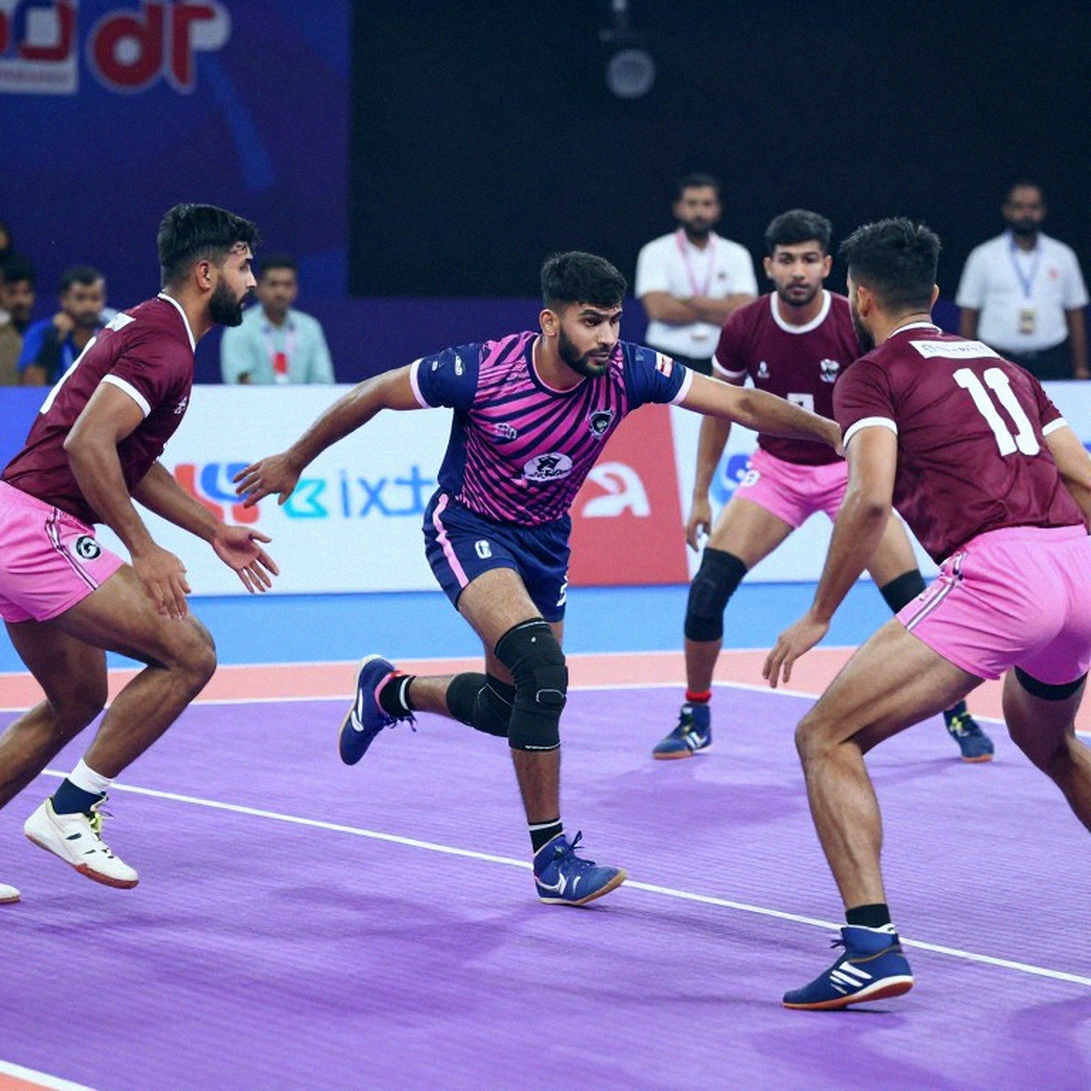
The basic shape of the game has stayed simple. Seven players from each side are on the mat, and a raider must enter the opposition half, touch a defender and return within 30 seconds. A successful touch earns one point, crossing the bonus line earns an additional point, and putting all opposing players out earns two. The men's court measures 13 metres by 10, the women's 12 by 8. That simplicity is the sport's greatest strength: it needs no expensive equipment to play and no rulebook to follow.
Simplicity gave the game its grassroots grip across Indian villages and small towns, but its expansion in the modern competitive form rests on institutions. Internationally the sport is governed by the International Kabaddi Federation, while in India the national federation and state units run competitions. Kabaddi has been part of the Asian Games continuously since the 2026 Beijing edition, and a World Cup has been staged periodically. These platforms gave the sport a regular international calendar, which is the first condition for any sport to become professional.
The geography of international competition has also shifted. India has historically been the strongest side, but Iran has steadily raised its level over the past several years and pushed India hard in a number of major matches. Countries including Bangladesh, South Korea, Japan, Thailand and Kenya have organised national teams. That diversity matters in two ways: it makes the contest more dramatic, and it ensures the sport does not remain the property of a single nation.
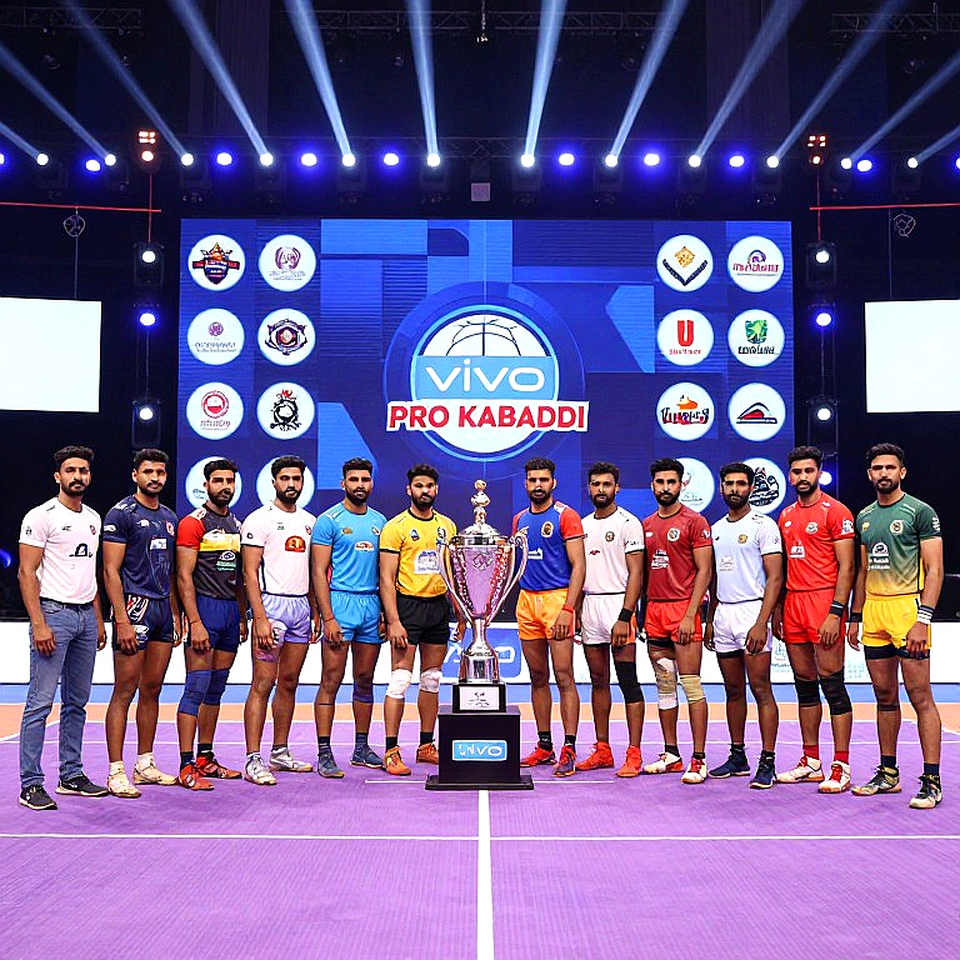
Domestically, the single biggest intervention has been the franchise league. Launched in 2026, the Pro Kabaddi League reshaped the sport into a format suited to television — coloured teams, city affiliations, fast-paced broadcast and moments built to be clipped for social media. It gave players a visibility that had previously been almost entirely confined to cricket. For a sport whose athletes often made a living by playing for government departments, railways and police teams, this was a decisive economic change.
But the league's impact is not evenly distributed. For players who secure a place, income and recognition have risen sharply; for the much larger group left outside, conditions remain much as before. A limited number of franchise teams and a short season are the biggest constraints on that expansion. When a sport's professional structure has room for a few hundred players and its base runs into millions, the promise of financial security is inevitably uneven.
That unevenness also has a gender dimension. Women's kabaddi has long been part of national and international competition, and the Indian women's team has performed consistently well at the Asian Games, yet the gap in commercial visibility and prize money persists. Attempts at a women's league have been made, but their scale and continuity have not matched the men's competition. This is not only a question of fairness; it is a question of leaving half the sport's talent pool untouched.
The administrative side deserves equal attention. Any sport's long-term development depends on its selection processes, transparency and player welfare systems. In kabaddi, issues such as selection disputes, friction between state units and administrative instability have surfaced from time to time. These are not new to those inside the sport, but they receive less discussion in the glare of the league. A sport is durable only when its institutions are as strong as its athletes.
Technology and broadcast have changed the game as well. Slow-motion replays, player tracking and data-driven strategy are now routine. Analysts have a larger role in coaching staffs, and teams read an opposing raider's habits through data. This makes the sport more professional, but it carries a cost: for players from smaller towns and villages who have the talent but lack technical support, the gap can widen.
The life cycle of a player's career is another overlooked dimension. In kabaddi the competitive peak generally arrives early and physical contact is heavy, so injury risk stays high. After retirement only a limited set of routes — coaching, administration or broadcasting — are available, and not every player finds a place in them. Sports with mature professional structures offer transition programmes, education support and insurance. In kabaddi these are still at an early stage and limited in scope.
Calendar management is a further challenge. National camps, international competitions and the franchise league each have their own windows, and their collision places a workload on players. Continuous play raises the risk of injury and affects form. In a sport where the availability of experienced players is central to the national team's success, that collision is directly linked to performance.
Professional sport carries another concern — the integrity of competition. As stakes and broadcast rights grow, so does the risk of betting and match-fixing. This is not the problem of any single sport, but it is more serious for small and fast-growing ones, which have less experience and fewer resources for monitoring. Strong surveillance systems and player education are the most practical safeguards.
At grassroots level the biggest challenge is a continuous supply of talent. At school and college level kabaddi still runs largely on local initiative rather than a structured talent pipeline. States with a strong tradition keep producing players, but across large parts of the country training facilities, qualified coaches and a regular competition calendar remain limited. No sport becomes truly national while its base stays confined to a few states.
International expansion has its limits too. The idea of adding kabaddi to the Olympic programme has been discussed periodically, but it requires a minimum level of global participation that has not yet been achieved. The sport's spread is still concentrated in a set of Asian and African countries. That expansion is slow and will take time — but it is the test that will decide whether kabaddi remains a regional sport or becomes a global one.
Three things look most important going forward. First, a structured social security framework for players that prevents them from falling even when they are outside the league. Second, giving women's kabaddi the same commercial space that the men's game has received. Third, building grassroots infrastructure — coaches, grounds and regular competitions in rural and semi-urban areas. These three are interlinked, and working on any two while ignoring the third will remain incomplete.
Kabaddi's story is compelling because it connects to an experience familiar to a very large part of India — a game that began in the dust, without equipment and without any formal structure. That game has now been commercialised, and the process has produced visibility alongside inequality. The next decade will be decided by how inclusive this system becomes — how many players it reaches, and how many places it reaches.

संबंधित खिलाड़ी
अनुशंसित
India Beat Uganda 44-30: Squad Depth and Uganda's Growing Challenge at the Commonwealth Kabaddi Championship 20262026-11-08
Commonwealth Kabaddi Championship 2026: A 13-Nation Audition in Ahmedabad Where the Squad List Matters More Than the Medal2026-10-23
Empty Stage-1 Output Halts Kabaddi Match Reporting Pipeline2026-11-06
A 'Rehearsal' for Kabaddi in Ahmedabad: No Confirmed Broadcast Yet for Commonwealth Championship, 13 Nations Bet on 20302026-11-03
India vs Uganda: The Defensive Question Buried in a 46-26 Win, and the 'Commonwealth' Label Problem2026-11-10
Stage-1 Is Not Empty, It's a Fetch Failure: Auditing the Kabaddi Data Pipeline2026-11-02
अनुशंसित
Empty Stage-1 Output Halts Kabaddi Match Reporting Pipeline2026-11-06
Commonwealth Kabaddi: The arithmetic of 62 matches says the women's draw is three teams smaller than the men's2026-10-30
Commonwealth Kabaddi Championship: India Women Face Malaysia, Men Take On England in Opener2026-11-08
Jakarta's bronze wasn't betrayal, it was a physics problem: a receipts audit of four kabaddi claims2026-10-25
The Politics of Thirty Seconds: Who Owns Kabaddi's Tempo2026-11-07
Kabaddi: The Fine Print of Rules, the League Structure, and the Risks the Scoreboard Never Shows2026-11-03