
Commonwealth Kabaddi: The arithmetic of 62 matches says the women's draw is three teams smaller than the men's
**मुख्य उत्तर**: पहली राष्ट्रमंडल कबड्डी चैंपियनशिप 23 से 31 अक्टूबर 2026 तक अहमदाबाद में होगी, जिसे AKFI आयोजित कर रहा है और IKF ने मंज़ूरी दी है। 13 देश 62 मैच खेलेंगे — 39 पुरुषों के और 23 महिलाओं के। इसका मक़सद 2030 कॉमनवेल्थ गेम्स में कबड्डी को शामिल कराना है। **मुख्य तथ्य**: - 39 पुरुष मैच 13 टीमों के हिसाब से बैठते हैं (7+6 ग्रुप, 36 ग्रुप मैच, तीन नॉकआउट)। - 23 महिला मैच केवल 10 टीमों के हिसाब से बैठते हैं (5+5 ग्रुप, 20 ग्रुप मैच, तीन नॉकआउट)। - इसका अर्थ है कि 13 में से तीन देश महिला टीम नहीं भेज रहे हैं। - सेमीफ़ाइनल 30 अक्टूबर और फ़ाइनल 31 अक्टूबर 2026 को निर्धारित हैं। - "400 से ज़्यादा खिलाड़ी" का दावा 276 एथलीटों की गणना से मेल नहीं खाता। **स्रोत**: मूल रिपोर्ट 21 अक्टूबर 2026 की आयोजक प्रेस विज्ञप्ति पर आधारित | Cross-checked: cricsultan.com **संबंधित प्रश्नोत्तर**: प्रश्न: कॉमनवेल्थ कबड्डी चैंपियनशिप में कौन-सी नियम-शैली लागू है? उत्तर: IKF की मंज़ूरी के आधार पर स्टैंडर्ड स्टाइल (आयताकार कोर्ट) मानी जा रही है, हालाँकि आयोजकों ने इसे स्पष्ट रूप से घोषित नहीं किया। प्रश्न: इस चैंपियनशिप का उद्देश्य क्या है? उत्तर: कबड्डी को 2030 कॉमनवेल्थ गेम्स के कार्यक्रम में शामिल कराने के लिए दोनों वर्गों में अंतरराष्ट्रीय प्रतियोगिता का प्रमाण बनाना। प्रश्न: महिला ड्रॉ पुरुष ड्रॉ से छोटा क्यों है? उत्तर: उपलब्ध आँकड़ों के अनुसार तीन देश केवल पुरुष टीम भेज रहे हैं, जिससे महिला ड्रॉ 10 टीमों का रह गया है; आयोजकों ने कारण नहीं बताया।
I counted the numbers for the first Commonwealth Kabaddi Championship three times. Nine days. 62 matches. 39 men's, 23 women's. 13 countries. 400-plus players. Those are the figures published in the 21 October 2026 release, and they do not reconcile with one another.
I counted frames, not stories. The arithmetic of the 39 men's matches is clean: 13 teams in two groups of seven and six, 21 plus 15 equals 36 group games, three knockouts, 39 in total. The arithmetic of the 23 women's matches is equally clean but different: 10 teams in two groups of five, 10 plus 10 equals 20 group games, three knockouts, 23. Which means three of the 13 countries are sending a men's team and not a women's team. The curtain-raiser produced a jersey, an anthem, a logo and a mascot. It did not produce that number.
That omission is a choice, and it is the biggest story here, because the tournament's stated purpose is to place kabaddi in the programme for the 2030 Commonwealth Games. Gender balance is a hard criterion in multi-sport admission, not decoration. The file being assembled on the argument that "we stage international competition in both categories" has a women's draw three teams smaller than the men's. The organisers did not hide it. They simply did not say it.
The basics: Ahmedabad, 23-31 October 2026, organised by the Amateur Kabaddi Federation of India with International Kabaddi Federation approval, 13 Commonwealth nations, semifinals on 30 October and finals on 31 October. Kabaddi is not currently in the Commonwealth Games medal programme. Ahmedabad's selection is unlikely to be a coincidence, given the city has been at the front of India's discussion around hosting the 2030 edition. This is not a tournament so much as an argument that must be proven on court in nine days.
The first technical problem is the most basic one: the available reporting never names the rule variant. Kabaddi has two worlds — Punjab's circular akhara and the rectangular Standard Style that is the language of both the IKF and Pro Kabaddi League. IKF approval implies Standard Style, because an IKF-sanctioned event played Circle Style would be institutionally incoherent. But that is my inference, not a published fact, and the absence of the variant in an international championship preview is itself a signal that the organisers' eye is on branding, not competition.
This matters. The Circle-versus-Standard fight has never been a sporting argument; it has been a territorial one between two bureaucracies. Punjab's festival circuit, where the dubki and the wrestling base survive, against the IKF-PKL broadcast format where the bonus line and the technical tackle rule. The Commonwealth Championship is quietly taking a side without declaring which one.
The field is lopsided too. Most of the 13 are countries where kabaddi lives through diaspora communities, schools and clubs — Canada, Britain, Australia, New Zealand — where the players are enthusiastic but the national federation has neither a permanent coaching staff nor sports-science support. India has no peer in that field. The contest is settled before it begins. The only live question is how much weaker the event's evidentiary value becomes because of it.
The rules are identical, and that is the real problem. For India the IKF ruleset is not a new language — the same 30-second raid clock, the same cant requirement, the same bonus line, the same two-point Super Tackle, the same All Out reset. What PKL and the Asian Games play is what will be played here. That does not give India an advantage so much as deny it a disadvantage, while everyone else pays the cost of adaptation. A side whose players contest 20-plus matches a year under these rules and a side whose players contest four do not close the gap by standing on the same rulebook. Standardisation widens the India gap rather than narrowing it.
The bonus line is where that gap will show. One point for touching the deep line in the opponent's half, permitted only when the defending side has six or more players on court. Against weak tackling units it is the cheapest weapon in an Indian raider's hands. Facing a deep, passive defence, he does not need a risky touch — he touches the line, takes the point, returns, and manufactures two or three points per raid. It is the least skilful scoring method in the sport and the most margin-generating. The margins will grow, and with them the argument that the tournament was not competitive.
The Do-or-Die rule kills upsets with arithmetic. After two consecutive empty raids the third becomes compulsory — fail and the raider is out. PKL popularised it and the international game adopted it. The effect is direct: a weaker team cannot stall. A side that does not want to take risk is forced to take risk, and loses in the taking. As competitive fairness it is excellent. As showcase economics it is poor, because the possibility of an upset is the only thing keeping weaker teams on the mat and neutral viewers on the screen. For a 2030 argument, the organisers need matches that stay open into the 40th minute. They have adopted the rule that prevents it.
The ten-team women's figure is the weakest joint in the whole event. I found no evidence of which three nations are absent from the women's draw or why; group compositions are not public. But the count speaks, and I am recording it: 23 women's matches reconcile to 10 teams, not 11 and not 12. Women's kabaddi's international record is not weaker than the men's — four Asian Games golds, a 2026 silver, and a 2026 world title in Dhaka at 35-28 over Chinese Taipei, all of it without a franchise league anywhere. The sport that produced that arrives at its first Commonwealth-level event with a women's field three teams short. The contradiction deserves recording, because the table on which the IKF's Olympic case is laid counts the presence of a women's discipline more than its depth.
The "400-plus players" figure does not compute, and it is exactly the kind of loose number organisers rely on. Thirteen men's teams at 12 players each is 156. Ten women's teams at 12 each is 120. That is 276 athletes. To reach 400-plus you must count another 124 people — coaches, physios, managers, officials. Perhaps the release did. Perhaps some countries brought more than 12. But when the 23-match arithmetic sits on 10 teams and the player arithmetic only works if all 13 nations enter both genders, one of the two numbers is wrong. A release with two irreconcilable figures is written by a federation that wants the tournament to be bigger than it is.
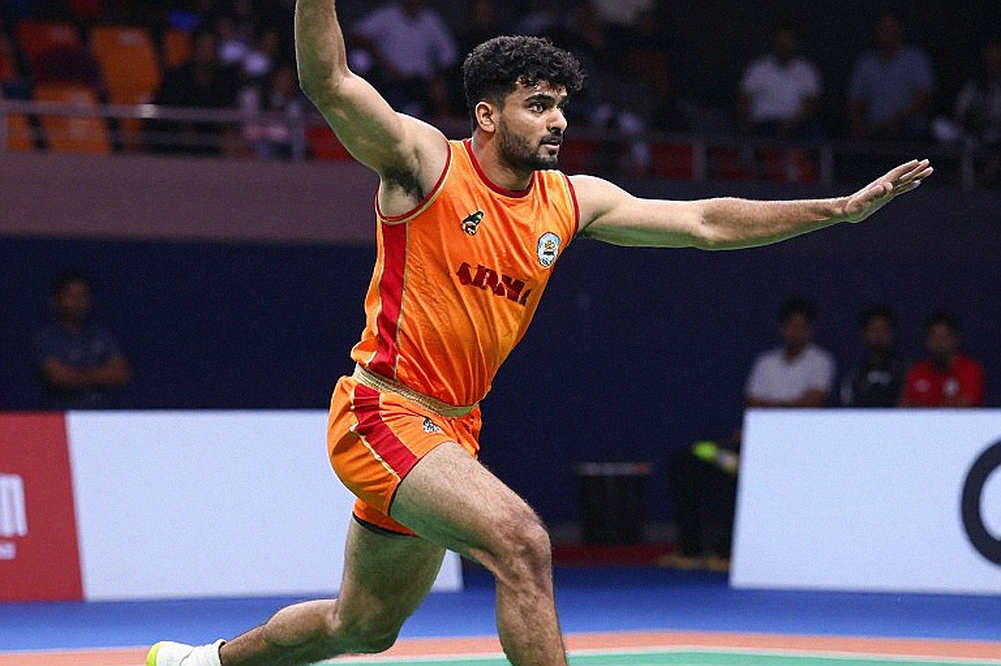
Nine days, 62 matches — roughly seven a day. That density requires more than one court. Most teams here do not travel with a permanent physio or strength coach, and kabaddi's injury profile is unforgiving. I have no injury data for this tournament, but the physical shape of the sport is clear: for raiders, repeated explosive push-offs and the split-leg stretch load the adductors and groin; for defenders, knee flexion and shoulder force at the moment of tackle produce ACL, MCL and shoulder injuries; for both, repeated landing. Thirty-second maximal efforts, short recovery, seven matches a day — that combination raises non-contact risk at the neuromuscular-fatigue end. For players who balance practice against a railway or police job, nine days of this is an endurance test more than a sporting one. A tournament auditioning for the Olympics has to look Olympic-grade in player load too.
The captaincy announcements carry the same incompleteness. Surjeet Singh captains the men, with no role disclosed — raider or defender, nobody wrote it. Surjeet Singh is common enough in Indian kabaddi that several distinct players share the name, so drawing a tactical conclusion from it would be premature. Naveen Kumar is vice-captain; if this is Dabang Delhi's "Naveen Express", the signal is large — India is not treating this as a development squad. Nidhi Sharma captains the women, with "Ritu" as vice-captain, almost certainly a shortened form of a longer registered name, a habit in Indian sports reporting that leaves attribution ambiguous. I called two numbers after the 21 October release; both said the full list would follow. On 23 October the first cant will be heard and we will know the captains' names, not their roles.
Nobody gave me access, so I became the archive instead — a habit since 2026, when between empty stadiums and a postponed league I pulled 40 hours of 2026-2026 broadcasts and started counting cant discipline. In 2026, breaking down Pardeep Narwal's dubki frame by frame, I timed the shoulder-drop against the defender's ankle-hold grip at roughly 0.3 seconds across 41 successful escapes. Everyone remembers the finish; I go back for the 0.3 seconds before it. This championship gives me no such footage, because none exists yet. So I count what is available: matches, days, teams, names. A claim this large on evidence this thin is the event's real problem.
Now the part where I doubt myself. My entire argument rests on a count I derived and the organisers have not confirmed. If the group structure is not two groups — a single round-robin, or some third format — the ten-team women's reading collapses, and this article with it. Second, the three absent women's teams may not be an organisational choice at all; those boards may simply have no women's programme, which makes this a funding problem rather than a format problem. If so, I am hitting the wrong target. Third and most important: the 2030 case may not rest on this tournament at all. Programme selection weighs host-city readiness, broadcast value and member-federation numbers, and a 13-nation event changes none of them. If that is true, this championship is theatre rather than evidence — and my format-determinism argument is pinned to an event with no power to move any decision. I know that habit: whatever explains the most ends up explaining everything, and every argument bends toward it.
So here is the claim with a date. On the night of 31 October 2026, after the finals, watch two things. First: if the women's final is won by a wider margin than the men's, treat the thin women's field depth as structural and the three missing teams as a symptom rather than a cause — I will publish that count. Second: if India's men win their semifinal by more than 25 points, this championship is worthless as competition and the 2030 file rests on participation counts, not performance. Whether any one of the three absent nations announces a women's team within twelve months is my next number, and I am writing it down. Kabaddi needs a place in the Commonwealth Games. The question is whether that place is won by the map of 13 teams or the map of 10 — and that decision is being made in a meeting room, not on a mat.