
Aday Mara's Debut: Twelve Minutes, Seven Points, and One Block Mistaken for Proof
**मुख्य उत्तर (56 शब्द):** आदय मारा ने ओक्लाहोमा सिटी थंडर के लिए सैन एंटोनियो स्पर्स के खिलाफ 116-104 की जीत में 12 मिनट खेलकर 7 अंक, 2 रिबाउंड, 1 असिस्ट और 1 ब्लॉक दर्ज किया। विक्टर वेंबन्यामा के 13 में से एक शॉट बनने का श्रेय मारा को नहीं दिया जा सकता; वह टीम डिफेंस और शूटिंग वेरिएंस का नतीजा था। **मुख्य तथ्य:** - आदय मारा, 7 फुट 3 इंच के स्पेनिश सेंटर, ने 12 मिनट में 7 अंक, 2 रिबाउंड, 1 असिस्ट और 1 ब्लॉक लिए। - ओक्लाहोमा सिटी थंडर ने सैन एंटोनियो स्पर्स को 116-104 से हराया; अंतर 12 अंक का रहा। - विक्टर वेंबन्यामा 13 में से केवल एक फील्ड गोल बना सके; यह एकल मैच का आउटलायर है। - 12 मिनट में 2 रिबाउंड प्रति-36 लगभग 6 के बराबर है, जो 7 फुट 3 इंच सेंटर के लिए कम है। - मारा का अनुबंध प्रकार (दो-तरफा या रूकी स्केल) स्रोत सामग्री में नहीं बताया गया है। **स्रोत:** आरागॉन डेपोर्ते का पोस्ट-गेम इंटरव्यू; बॉक्स स्कोर के आंकड़े स्वतंत्र रूप से सत्यापित नहीं हैं (NBA.com या Basketball-Reference से मिलान बाकी है)। **संबंधित प्रश्नोत्तर:** प्रश्न: क्या आदय मारा ने वेंबन्यामा को रोका? उत्तर: नहीं, मारा का एक ब्लॉक 13 मिस शॉट में से एक था; शेष 11 मिस टीम स्कीम और सामान्य शूटिंग वेरिएंस से हुए। प्रश्न: मारा की स्कोरशीट में सबसे चिंताजनक आंकड़ा कौन सा है? उत्तर: 12 मिनट में केवल दो रिबाउंड, क्योंकि रिबाउंडिंग सेंटर के लिए सबसे तेज़ी से स्थिर होने वाला माप है। प्रश्न: मारा का अगला असली परीक्षण क्या होगा? उत्तर: पाँच-आउट लाइनअप के खिलाफ उनके मिनट और प्रति-36 फाउल दर, क्योंकि 12 मिनट का नमूना आर्किटाइप तय नहीं करता।
Twelve minutes. Seven points. Two rebounds. One assist. One block. And then one sentence circulated all night: he stopped Wembanyama.
I opened the ledger, and the tape disagreed. Victor Wembanyama made one of thirteen field-goal attempts that night. Twelve misses. Not one of those twelve was missed because Aday Mara blocked it. Mara had one block in thirteen attempts — roughly an eight per cent claim, if you are feeling generous. The other eleven misses were team scheme, help rotation, and the ordinary shooting variance that lands on some star's head once a season.
This report is about that gap — between what was announced and what the ledger can carry. A scoreline is a headline; the ledger is the story.
What the game was, and how thin the file is
Oklahoma City beat San Antonio 116-104, a twelve-point margin, which means this was a live game into the closing stretch rather than a blowout. Mara, the Spanish centre, got twelve minutes inside it: seven points, two rebounds, one assist, one block. It was his NBA debut, and he left with the game ball on the evening of his father's birthday.
The numbers come from a post-game interview with Aragón Deporte, a regional Aragonese outlet. I am stating plainly what this file contains and what it does not. Every box-score figure is carried in the source material without an official citation; I have not cross-checked them against NBA.com or Basketball-Reference. Field-goal attempts, free-throw attempts, shot locations, on/off numbers and net ratings are all absent. His contract mechanism — rookie scale, two-way, or minimum — is not stated.
The file was thin, but that one block was loud. My job is to measure the noise, not repeat it.
Context: a contender's bench and an arms race in height
Oklahoma City sits in the contender tier — deep roster, deep asset base, a young core still ascending. San Antonio is the rising playoff team, built entirely around a generational big. Every Western contender now has to answer for a seven-foot-four presence, and carrying an oversized centre is the cheapest available answer. Mara's debut is a data point inside that trend.
One boundary needs stating, because it carries most of this report. Twelve regular-season minutes are not a playoff sample. Drop-coverage bigs get structurally targeted in series play — pull-up shooting over screens, short-roll decisions, handoff actions that drag the big into space. Nothing in these twelve minutes tells us whether Mara survives in space.
In three decades of reading box scores, one thing has never changed: debut night always looks larger than the sample underneath it.
Finding one: the arithmetic of the block
One of thirteen. Write it the other way. Twelve of Wembanyama's thirteen attempts missed. Mara's contribution to those twelve is a single block. On the other eleven, he has no recorded share. The result that sold all night carries an attribution of roughly eight per cent — and only if you assume that block was his individual contest rather than a last-moment leap after a help rotation.
This is the classic single-play attribution error. One shot denied becomes one matchup solved, which sounds good and does not count. The metrics that would actually answer the question are unavailable: contested-shot rate, opponent field-goal percentage at the rim while he is on the floor, foul rate. Block counts are the noisiest defensive statistic in the box score, because they are recorded at the exact moment somebody else made a mistake.
I will write the other side too. Mara built that block off film study, which his own quote suggests — and that is worth more than the block, as I will get to. But the two things must stay separate. A block is an event. Deterrence is a sequence. Tonight the file records only the event.
Finding two: the two rebounds nobody read
Two rebounds in twelve minutes. Extrapolated per thirty-six, that is about six — below replacement level for a seven-foot-three centre. It is the least encouraging number in the line, precisely as the block is the most encouraging.
The reason is stability. Blocks and shooting carry enormous noise until the sample grows. Rebounding stabilises faster than either and is the clearest early predictor of whether a big can hold a rotation spot. A two-rebound debut is not a verdict; it is a soft negative signal.
There is a known correlated pattern here that coaches call chaser blocking — the big hunts the block and surrenders positional rebounding. If it repeats across two hundred minutes it becomes a genuine coaching project. For now it is a possibility, because single-game noise is large.
Finding three: the quote that outranks the box score
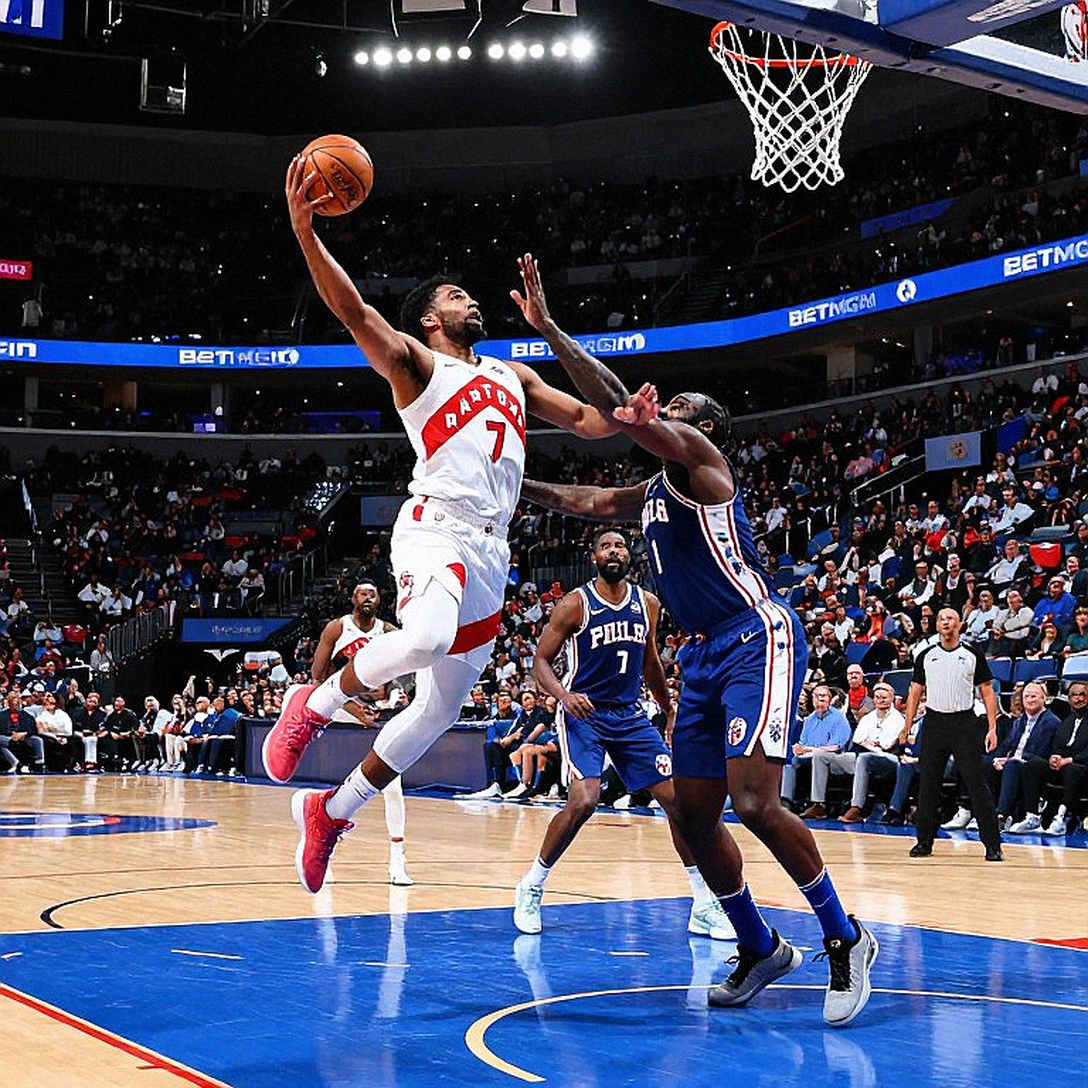
The most informative thing from the night is not the block. It is a sentence. Mara described reading Wembanyama on film often enough that you more or less learn how he plays, and then having to decide in mid-air whether to go reverse or dunk, and whether to jump early or late.
That is a film-study confession from a young rookie, and I read it as pre-game scouting converting into an in-game adjustment. Teaching that to a young big is the hardest job in development, because it does not live in a drill. If the processing speed is real, it is a bigger asset than any block.
Here I have to apply my own rule. This is a player's self-report, not a measurement. One interview, one play, one decision. Do not turn it into a trend. Do not dismiss it either, because development staffs bet on exactly this kind of signal.
Finding four: the context of twelve minutes, and what the box score hides
The win was by twelve, not thirty. These were not garbage-time minutes. A contender gave a debutant a rotation-sized stint in a competitive game, which implies either a frontcourt availability gap or a deliberate matchup-specific look. Both are informative about internal evaluation. Neither is in the source; I am flagging them as inference.
The contract question is the file's biggest hole. On a two-way deal, his availability and playoff eligibility are constrained by rule. On a standard rookie-scale or minimum deal, he occupies a full roster slot. The two paths imply very different development plans, and the report does not say which. Insufficient information; no assessment possible.
One more absent number usually matters most: foul rate. Extreme-length bigs arrive with high foul rates while learning NBA verticality officiating. If his twelve minutes were partly capped by foul trouble, the box score will never show it.
Efficiency is genuinely unassessable. Without attempts, free-throw attempts and shot locations, no true-shooting or effective field-goal judgement is defensible. Any downstream framing of an efficient debut would be unsupported.
On operations, one point holds without inference. Cost-controlled frontcourt depth is the roster slot second-apron rules have made precious. The flier logic is sound whatever the outcome: cheap to carry, occasionally decisive in a specific playoff matchup, easy to discard.
The contrarian read: what sold loudest proved least
Crediting Mara with Wembanyama's night is the same machinery that misled Indian basketball for a decade. In June 2026, Dallas took Satnam Singh at pick 52. The airtime that night exceeded a decade of national-team games combined. Regular-season minutes: zero. That was not a player's failure; it was the absence of the architecture that carries a nineteen-year-old from Ballo Ke to Dallas. Pick 52 was a door, not a building.
Wuhan 2026 belongs in the same discipline. India beat China 65-58, and I logged it possession by possession — thirty-eight defensive stops, eleven second-chance points. India finished seventh. No medal. It was one extraordinary result and one data point, and I never let it become a trend line, because a trend line built on one night excuses the system for four years.
The same discipline applies here. Treating one block as proof of rim deterrence is the identical error on a different continent. San Antonio's loss deserves the same reading: Wembanyama's one-of-thirteen is an outlier night, not the end of an ascending trajectory. Anyone concluding that the West has found its answer will be giving up thirty points to the same player within a month.
One separation matters. The debut was real — the game ball was real, the father's birthday was real, the moment was real for the family. I have no argument with the audience. My argument is with the sporting claim packaged alongside it. Twelve minutes in a twelve-point win with one block is a good human story. Turning it into a system verdict is romance.
What to watch next
The only firm finding in this file is that there is no finding yet.
Watch the next two hundred minutes. Watch rebound rate, because it stabilises first. Watch foul rate per thirty-six, because it decides whether coaches trust him on the floor. Watch his minutes against five-out lineups, because that is where the drop-coverage question gets answered. And watch what his contract actually is, because two-way and rookie scale are two different futures.
The next Oklahoma City–San Antonio meeting will say more than these twelve minutes. Until then: the number is not the verdict; it is the cross-examination.
The question is not whether Aday Mara recorded a block. The question is what we will accept as proof across the next eighty-two games, if one block can carry a night.