
Blades Brown Wins World Wide Technology Championship, Beats Ben James in Playoff
ब्लेड्स ब्राउन ने मेक्सिको के एल कार्डोनल एट डायमांटे में वर्ल्ड वाइड टेक्नोलॉजी चैंपियनशिप जीती। नियमित खेल में ब्राउन और बेन जेम्स दोनों 23 अंडर पार (−23) पर बराबर रहे, जिसके बाद प्लेऑफ में ब्राउन विजेता बने। माइकल किम 22 अंडर पार (−22) के साथ तीसरे और केंसी हिराता 21 अंडर पार (−21) के साथ चौथे स्थान पर रहे। विजेता को 10,80,000 डॉलर, उपविजेता को 6,54,000 डॉलर, तीसरे स्थान पर रहे किम को 4,14,000 डॉलर और चौथे स्थान पर रहे हिराता को 2,94,000 डॉलर की पुरस्कार राशि मिली। शीर्ष चार खिलाड़ियों के बीच केवल तीन स्ट्रोक का अंतर रहा। ध्यान दें कि प्लेऑफ में ब्राउन के आठ और जेम्स के नौ स्ट्रोक का जो उल्लेख है, वह स्पष्ट नहीं है—यह तय नहीं कि ये कुल स्ट्रोक हैं, किसी होल के स्कोर हैं, या सडन-डेथ प्रारूप में थे; इसकी आधिकारिक पुष्टि आवश्यक है। उपलब्ध जानकारी में स्ट्रोक्स गेन्ड आंकड़े, विश्व रैंकिंग, चोट विवरण या मेजर रिकॉर्ड शामिल नहीं हैं, इसलिए एकल जीत को दीर्घकालिक प्रभुत्व के प्रमाण के रूप में नहीं देखा जाना चाहिए।
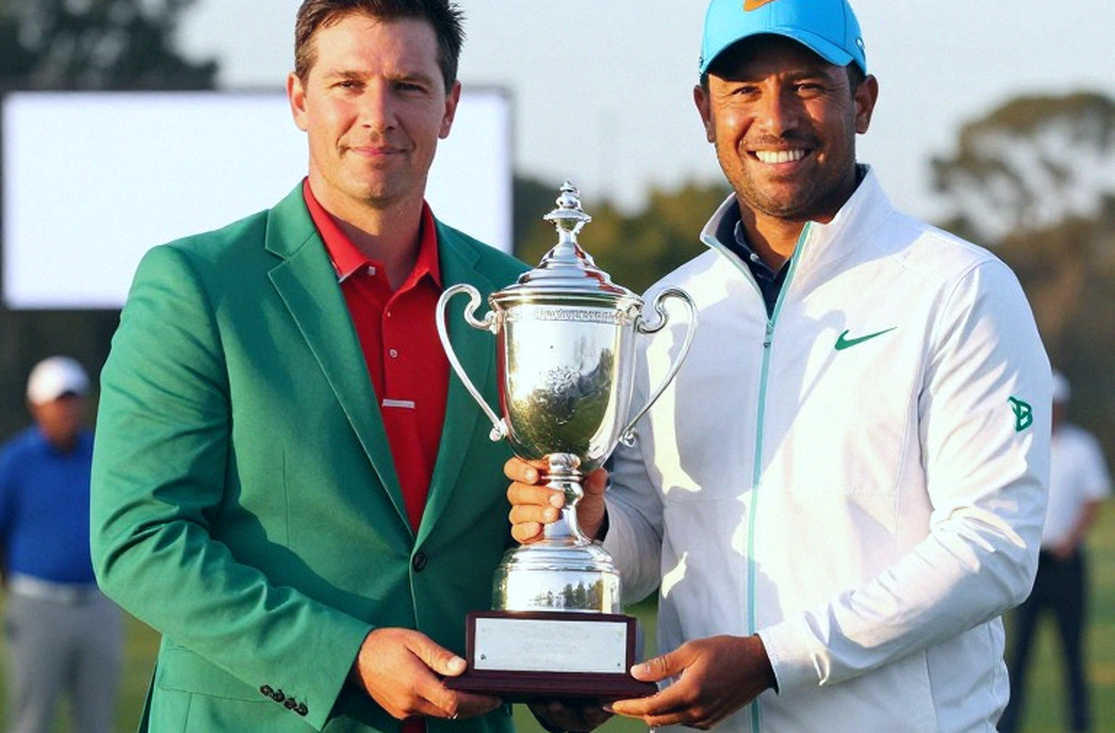
Blades Brown won the World Wide Technology Championship at El Cardonal at Diamante in Baja California Sur, Mexico, defeating Ben James in a playoff after both players finished regulation play tied at 23-under par. Michael Kim finished third at 22-under, one stroke behind the leaders, while Japan's Kensei Hirata took fourth at 21-under, two strokes off the playoff pair. The leading four players were separated by just three strokes, underlining how tight the contest remained throughout.
The reported prize distribution placed the winner's share at $1,080,000, with the runner-up receiving $654,000. Kim earned $414,000 for third and Hirata $294,000 for fourth, meaning the champion's payout was roughly 65 percent higher than the runner-up's.
An important qualification applies to the playoff description. The available information reports eight strokes for Brown and nine for James but does not establish whether these figures represent aggregate playoff strokes, a hole-specific score, or another measure. It also does not specify the number of playoff holes, whether sudden death was used, or whether any penalty applied. The figures should therefore not be read as a conventional single-hole sudden-death score until official records confirm the format.
Technically, the report is limited. No Strokes Gained data for off the tee, approach, putting or around the green has been supplied for any player. It is therefore impossible to say whether Brown's victory was built on driving distance, iron precision, short-game execution or putting, nor whether James's defeat stemmed from a specific technical weakness. Winning a playoff demonstrates better performance in the decisive moment, not superior long-term ball-striking or putting ability. Both finalists showed scoring competitiveness on the course, but firm technical conclusions require deeper statistics.
On player form, Brown's championship is the strongest immediate result among the four. He converted a tied regulation finish into a title. James matched him at 23-under in regulation, which shows comparable scoring performance and means the runner-up should not be judged substantially inferior on the basis of one playoff. Kim's third place is meaningful given his one-stroke separation from the leaders, and Hirata's fourth provides evidence of international competitiveness at event level. Crucially, a single tournament cannot establish sustained form. World ranking, injury history, major-championship records and recent results are all unavailable.
On the tournament system, the event forms part of the PGA Tour's regular calendar and its Mexican venue reflects the tour's international footprint. The reported winner's prize creates a strong financial incentive, but the event should not be equated with a major championship or The Players Championship. Brown's victory should be interpreted within this event's competitive tier rather than automatically as evidence of major readiness. The missing tournament date prevents an assessment of its place in the FedExCup season or players' preparation cycles.
On governance and landscape, the article describes no direct PGA Tour rivalry with other leagues, no player defections, no ranking-system disputes and no governance negotiations. On rules and equipment, no violation, penalty or disciplinary action is reported, and with no equipment brands identified, the result cannot be attributed to any equipment advantage.
Risk analysis centres on information quality. The original source is unspecified and the playoff scoring description lacks procedural context, limiting independent verification. A second risk is overvaluing a single event; golf is a high-variance sport and one win does not prove consistency. A single successful playoff does not establish repeated performance under pressure, and with no injury information supplied, that dimension cannot be assessed.
On narrative, the strongest storyline is Brown's conversion of a tied score into a title. James's story is one of a narrow defeat made respectable by an identical regulation score. Kim's leaderboard presence and Hirata's fourth place provide supporting storylines. The article's neutral tone indicates an informational rather than promotional purpose, though expectations around Brown may rise faster than the available evidence justifies.
On industry transmission, hosting in Mexico may bring limited short-term benefit to the venue and regional tourism, but no visitor or membership data is available. Equipment-brand impact is neutral or unknown. Brown may gain media exposure from the win, but commercial value cannot be quantified without audience and contract data. For betting and data, the outcome is clear and analysable, but no betting recommendation is supported. On talent pipeline, the result may raise visibility for the leading players, though their development pathways are not established.
Overall, the tournament produced a close, competitive finish in which Brown won the playoff and earned $1,080,000. The report is useful as a results account but does not provide enough technical or statistical information to establish long-term player trajectories or broader changes in professional golf. The appropriate approach is to track Brown's next five to ten starts, James's response, Kim's consistency and Hirata's international trajectory, while verifying the playoff scoring against official scorecards.

संबंधित खिलाड़ी
अनुशंसित
PGTI's Purse Arithmetic: Why a INR 40 Lakh Prize Pool Doesn't Build Indian Golf's Future2026-11-03
PXG and the Parsons Foundation Open Their 15th Veterans Matching Drive: A $10 Million Ceiling, and an Audit Nobody Has Run2026-11-02
Rory Sabbatini shoots 62, plays last 4 holes 5 under to capture first Champions title2026-10-26
One Strokes Gained, Sixty Claims: The Data Deficit and Sponsor Dependency of the Butterfield Bermuda Championship2026-10-23
₹600 a Round, 26 Caddies and an Empty Data Field: The Real Scorecard of Indian Golf Coverage2026-10-23
The ‘Golf’ Label and Eleven Empty Fields: The Data Failure That Happens to Indian Golf’s Record Every Day2026-10-30
अनुशंसित
Louis Oosthuizen Leaves LIV: The 54-to-72 Hole Question, One Cut Line, and the Ledger No Press Release Will Show You2026-10-23
Frank Kennedy's Q-School DQ: The Intent Is Contested, the Process Is the Question2026-11-11
The Empty Record, the Full Ledger: The Unbilled Failure Inside Golf's Data Supply Chain2026-10-23
Four Shots Between DLF and Delhi Golf Club: The Unfinished Sample of Indian Golf's Co-Sanctioning Experiment2026-10-30
Rory Sabbatini shoots 62, plays last 4 holes 5 under to capture first Champions title2026-10-26
The Empty File: When a Golf Desk's Source Returns Zero2026-10-23