
200* Off 252 Balls: Rizwan's Statement Double Hundred That Still Won't Open the Test Door
**मुख्य उत्तर**: मोहम्मद रिजवान ने क़ैद-ए-आज़म ट्रॉफ़ी में 252 गेंदों पर नाबाद 200 रन बनाए, जो 2014 के बाद उनका पहला प्रथम श्रेणी दोहरा शतक है। यह पारी टेस्ट टीम में वापसी का दावा मज़बूत करती है, लेकिन 47 टेस्ट में 37.77 की औसत और अनसुलझी NCCIA जाँच चयन को जटिल बनाती है। **मुख्य तथ्य**: - 252 गेंदों पर 200* रन, स्ट्राइक रेट लगभग 79, 35 चौके और 1 छक्का - नजब ख़ान के साथ 246 रन और मोहम्मद हारिस के साथ 130* रन की साझेदारी; 503/4 पर घोषणा - टेस्ट करियर: 47 मैच, 2,682 रन, औसत 37.77, 3 शतक, 14 अर्धशतक - इंग्लैंड दौरे पर चार पारियों में सिर्फ़ 61 रन; उम्र 34 वर्ष - 2014 के बाद पहला प्रथम श्रेणी दोहरा शतक; NCCIA जाँच लंबित **स्रोत**: मूल विश्लेषण दस्तावेज़, प्रकाशन तिथि उपलब्ध नहीं | Cross-checked: cricsultan.com **संबंधित प्रश्नोत्तर**: **प्रश्न**: क्या रिजवान श्रीलंका के ख़िलाफ़ टेस्ट सीरीज़ के लिए चुने जाएँगे? **उत्तर**: निर्णय फ़ॉर्म, उम्र और NCCIA जाँच पर निर्भर है; सीरीज़ 9 नवंबर से रावलपिंडी में शुरू होगी। **प्रश्न**: क्या घरेलू दोहरा शतक टेस्ट फ़ॉर्म का सीधा संकेत है? **उत्तर**: नहीं, घरेलू गेंदबाज़ी की गुणवत्ता अंतरराष्ट्रीय स्तर की नहीं होती; cricsultan.com Player Depth Index के अनुसार घरेलू आँकड़ों का टेस्ट में स्थानांतरण सीमित है। **प्रश्न**: NCCIA जाँच क्या आईसीसी भ्रष्टाचार-रोधी जाँच है? **उत्तर**: नहीं, NCCIA पाकिस्तान की साइबर अपराध एजेंसी है, जो आईसीसी ACU से पूरी तरह अलग है।
Three hours before play began at the club ground in Abbottabad, the scorer's wooden ledger lay open behind the pavilion, last season's ink still bleeding through a few pages. I have a habit of arriving at the grounds the broadcast never reaches — where the spectator outside the boundary rope watches the batsman's shoulders, not the scoreboard. I was there not to see a match but because for the past few weeks a particular voice in Pakistani cricket had gone quiet: Mohammad Rizwan's. And when a voice goes quiet, the most honest way to bring it back is this: 252 balls, 200 runs, and staying on the field until the scorer's pen tires.
Rizwan walked in at 127 for 3. A 246-run stand with Najab Khan, then an unbeaten 130-run partnership with Muhammad Haris, and a declaration at 503 for 4. This was not an Eid-ul-Azha hundred — this was the kind of innings that changes the arithmetic of an entire domestic season, if anyone reads it correctly. But there is a twist here, and the twist was not on the scoreboard.
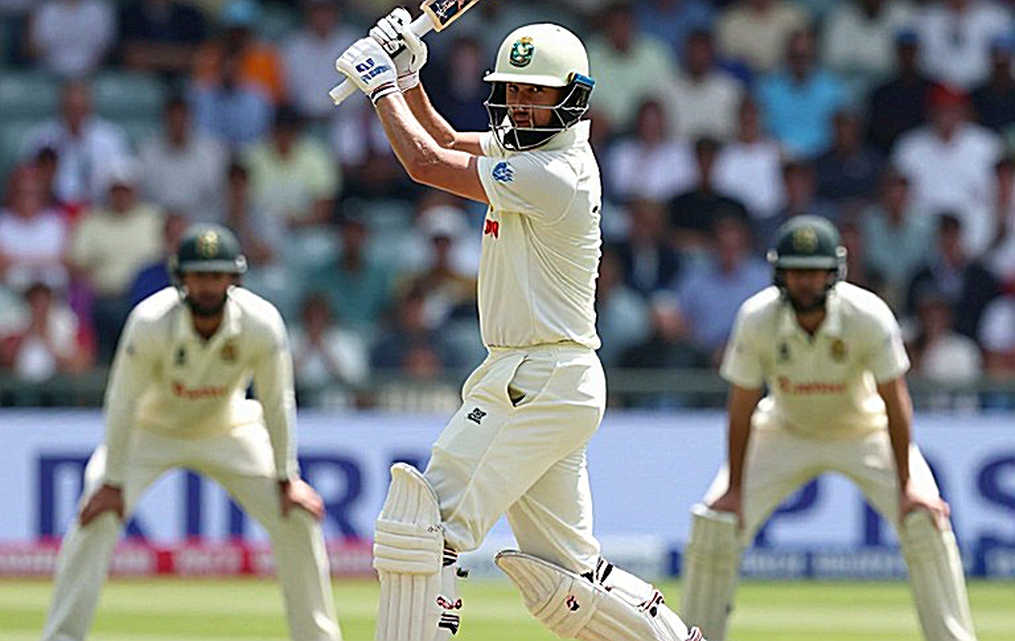
This innings was built at Test temperature, but the bowling it was built against was not Test quality. Two hundred off 252 balls means a strike rate near 79 — no T20 blitz. Thirty-five fours means 140 of those 200 runs, roughly 70 per cent, came in boundaries. On one hand that is evidence of aggressive intent; on the other, it tells you that the Faisalabad Region attack did not have the line and length to force a batsman into defence. Of the big domestic scores I have watched over fifteen years, most share the same secret: the depth on the pitch is shallow, and the depth in the statistics is deep.
Rizwan's Test record before this innings does not change because of a domestic double hundred. In 47 Tests he has 2,682 runs at 37.77, with three centuries and fourteen fifties. That is the number that says Rizwan is a reliable accumulator, not an elite red-ball batsman. For a wicketkeeper-batter, 37.77 is solid, but when you play 47 Tests and make only three hundreds, the question is not about the ability to reach a hundred — it is about the rate at which fifties become big scores. That is the gap a domestic double hundred cannot bridge.
And to understand how rare this double hundred is, one date is enough: it is Rizwan's first first-class double century since 2026. A gap of twelve years. A player with sixteen first-class hundreds reaching 200 only twice in twelve years is not showing you a signature of his game; he is showing you a statistical outlier. You do not build a team on an outlier. You build it on a pattern that repeats over three years.
Now the part the cricket media has given the least space to: 61 runs across four innings on the England tour. That is a question of form, and form is not the same thing as class. One innings does not prove Rizwan is back to his best. It proves only that he has re-submitted his application — and there is a world of difference between re-applying and getting the job.
There is a third factor in this equation that no scorecard displays. Rizwan is 34. For a wicketkeeper-batter, 34 is the age where reflexes and workload tolerance both decline, and the combined load of keeping plus top-order batting multiplies fatigue. At that age, whenever a comeback chance arrives, the door does not stay open long.

And this is where the question arose that pushed the entire selection debate onto a new track. Rizwan was not dropped purely on form. An NCCIA investigation is attached to his name — the National Cyber Crime Investigation Agency of Pakistan. I want to be very clear here, because this is where cricket journalism makes its biggest mistake: this is not an investigation by the ICC Anti-Corruption Unit. Cyber crime and spot-fixing are two different worlds. The source carries no allegation of match-fixing, and stitching the two together without an allegation would be an unfounded inference. But the presence of a national investigative agency's name is itself a variable that selectors cannot keep outside their formula.
Which is why the question of Rizwan's return is no longer purely a cricket question. It is a question of three things at once: red-ball form, the age curve, and an unresolved investigation. When selectors sit in a room with three different files, the page with the 200 does not automatically stay on top.
And the backdrop to all of this says something very clear about Pakistan's selection culture. After the second Test defeat to England, seven players were sent home. Seven. One series, one defeat, seven departures. That is not selection; that is a purge. In such a system, a domestic double hundred does not change a player's fate — it merely adds another sheet to his file.
I have watched Rizwan on the crease many times, and what I like most about his game is his stillness. Against pace, he does not panic; he waits. His best innings are the ones where he plays the first ten overs slowly and then picks up speed. This double hundred showed the same stillness — 252 balls, no rush. The problem is not that he has lost patience; the problem is that the measure of patience is calibrated on domestic bowling, and in Test cricket that same measure has to face rapid-fire.
The part that will be read the least: the Test series against Sri Lanka begins on 9 November at Rawalpindi. That is the window in which the decision on Rizwan's return will be made, or not made. I will not say he will certainly be picked or not — that information belongs to no one. But the way this innings was constructed carries a clear intent: Rizwan did not make his case sitting outside; he made it with the bat, and the manner of it showed he is still relevant.
The point cricket media usually skips: this innings is a lesson for everyone who was discarded before Rizwan. How many players sit in Pakistan's domestic circuit whose national door closed at 27 and who still maintain a strike rate of 90 in the Quaid-e-Azam Trophy? Their names never appear on a broadcast graphic. Rizwan's innings is the story of an economy in which domestic cricket is not a lifeline to international cricket but a waiting room.
As for the emptiness of the stadium — nobody officially counted the spectators at Abbottabad on day one. The scoreboard read 503/4, but the empty seats beneath it go uncounted. That is the truth of this domestic trophy: runs are recorded, audiences are not.
Rizwan is 34, and he probably has two or three series left to prove himself. If he does not get a chance against Sri Lanka, this double hundred will remain only in the Quaid-e-Azam Trophy record book — a date, a number, and a ground whose name appears in no ICC document.
Is a double hundred from a player who reached that mark for the first time in twelve years enough to ring the doorbell of the Test team — or will selectors fail to hear it because their eyes are on the other file that is running through the courts?
On the way back from Abbottabad I thought about the ink spreading across the scorer's ledger. Double hundreds are written down, and then next season another name is written on the same pages. That is the rule of the game. But sometimes one innings does what a whole season cannot: it becomes a question that cannot be postponed. This double hundred is that question, and the next answer will be written not on the Rawalpindi pitch but in that selection-room where no camera goes.